CONTENTS
Artem Mykolaichuk
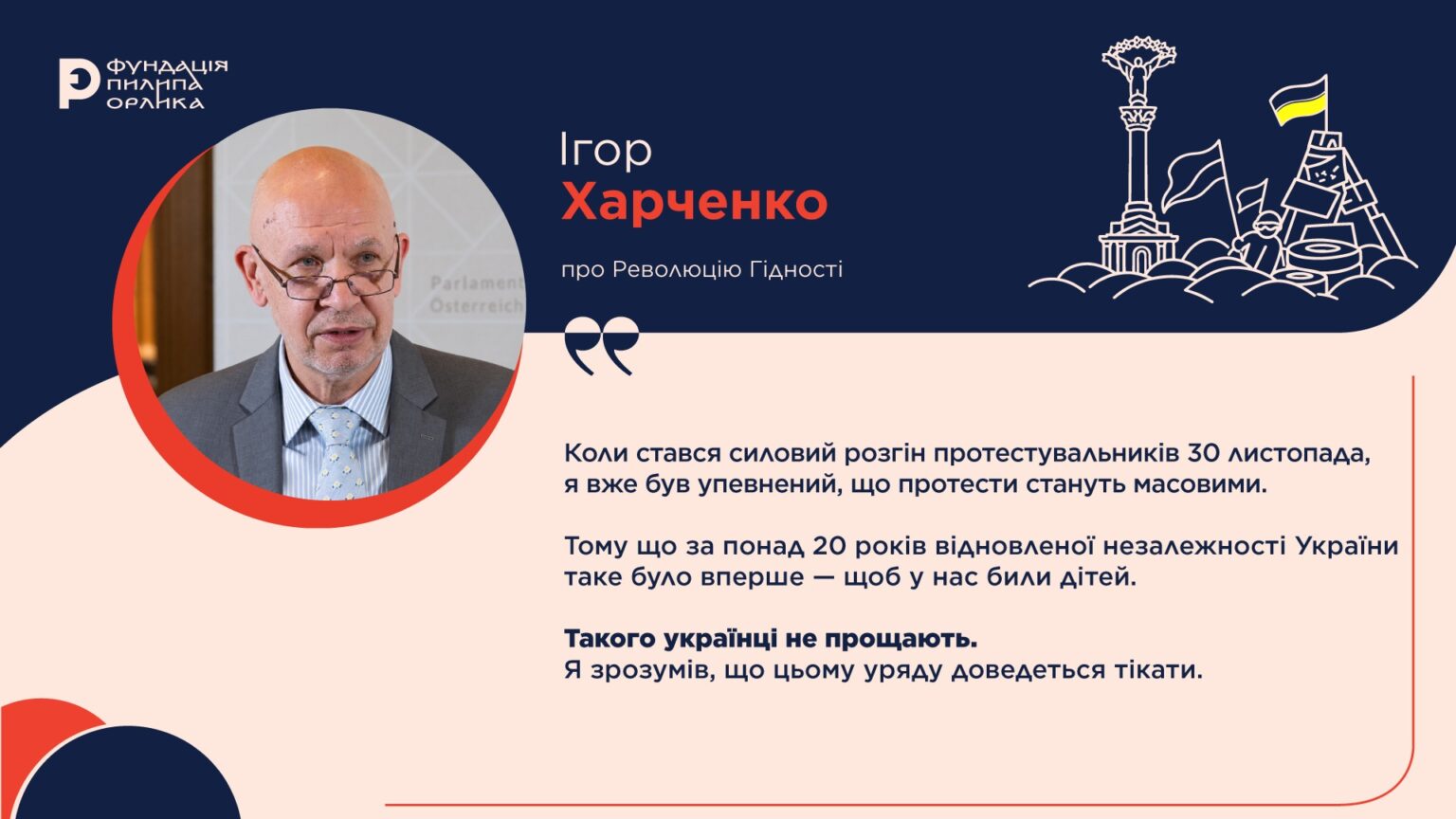
Ihor Kharchenko
Anzhelika Rudnytska
Kseniia Mykhailina
Katia Maksym
Kseniia Dvornikova
Vasylyna Duman
Volodymyr Yelchenko
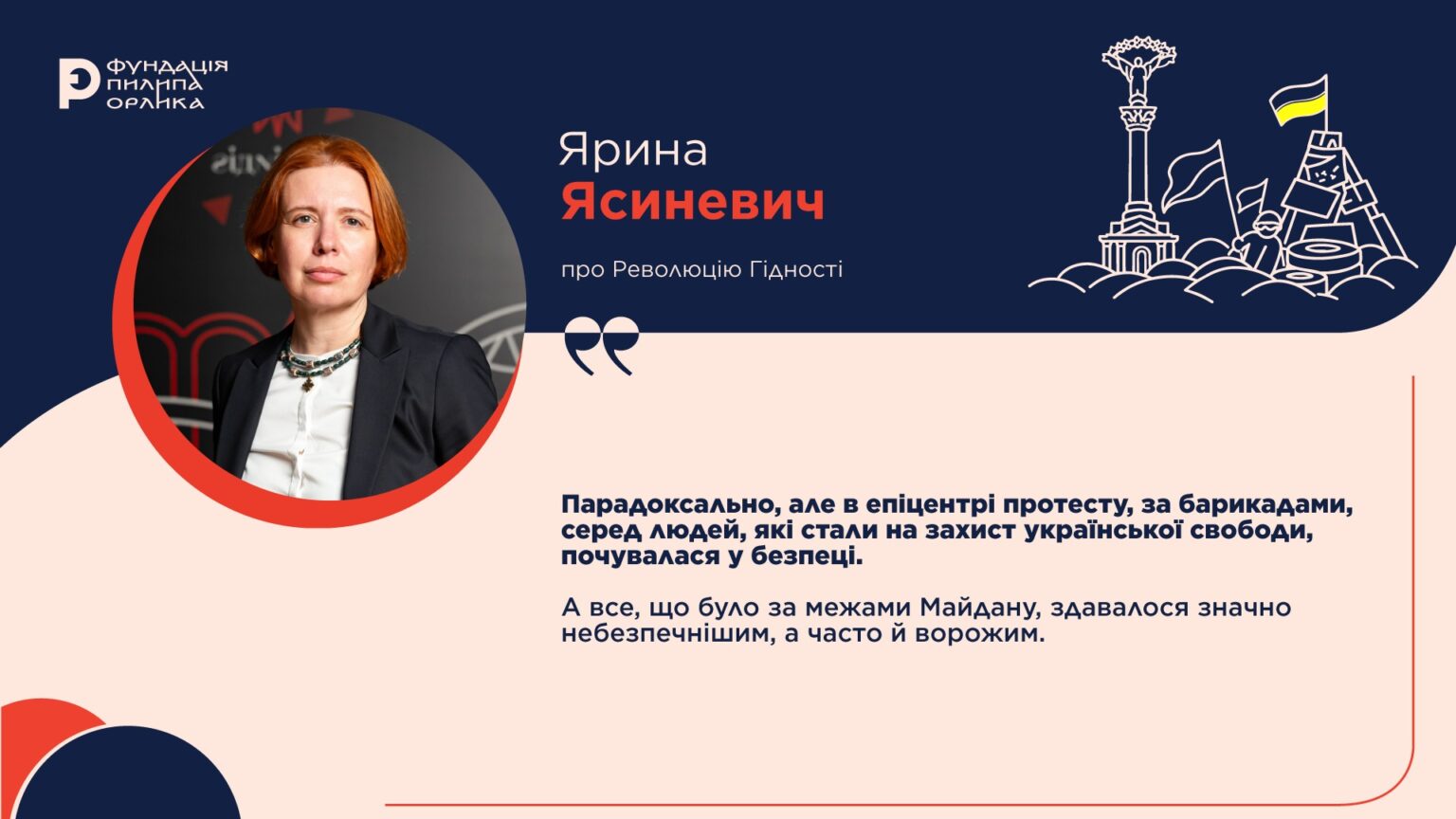
Yaryna Yasynevych
Svitlana Kvitnytska
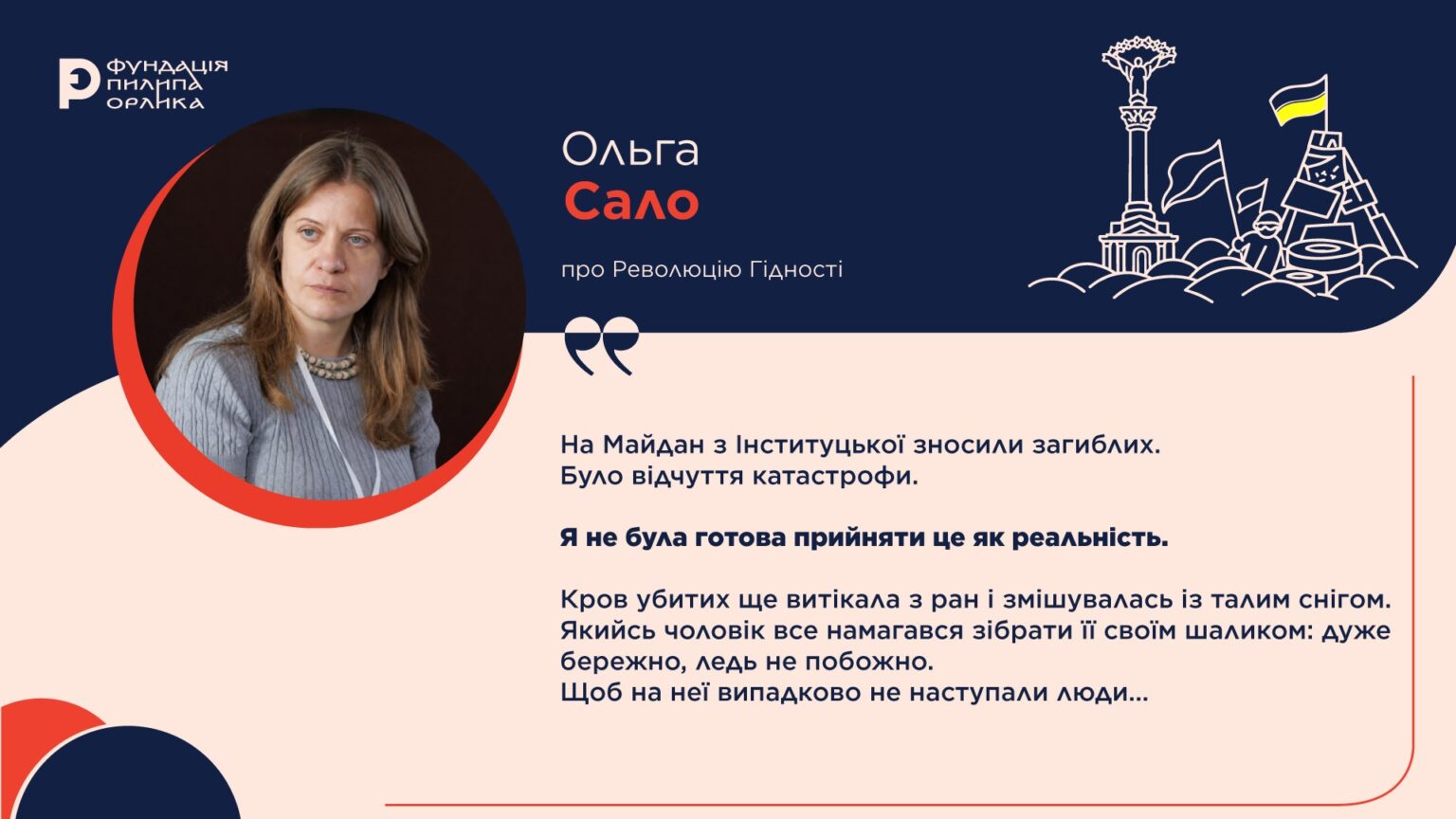
Olha Salo
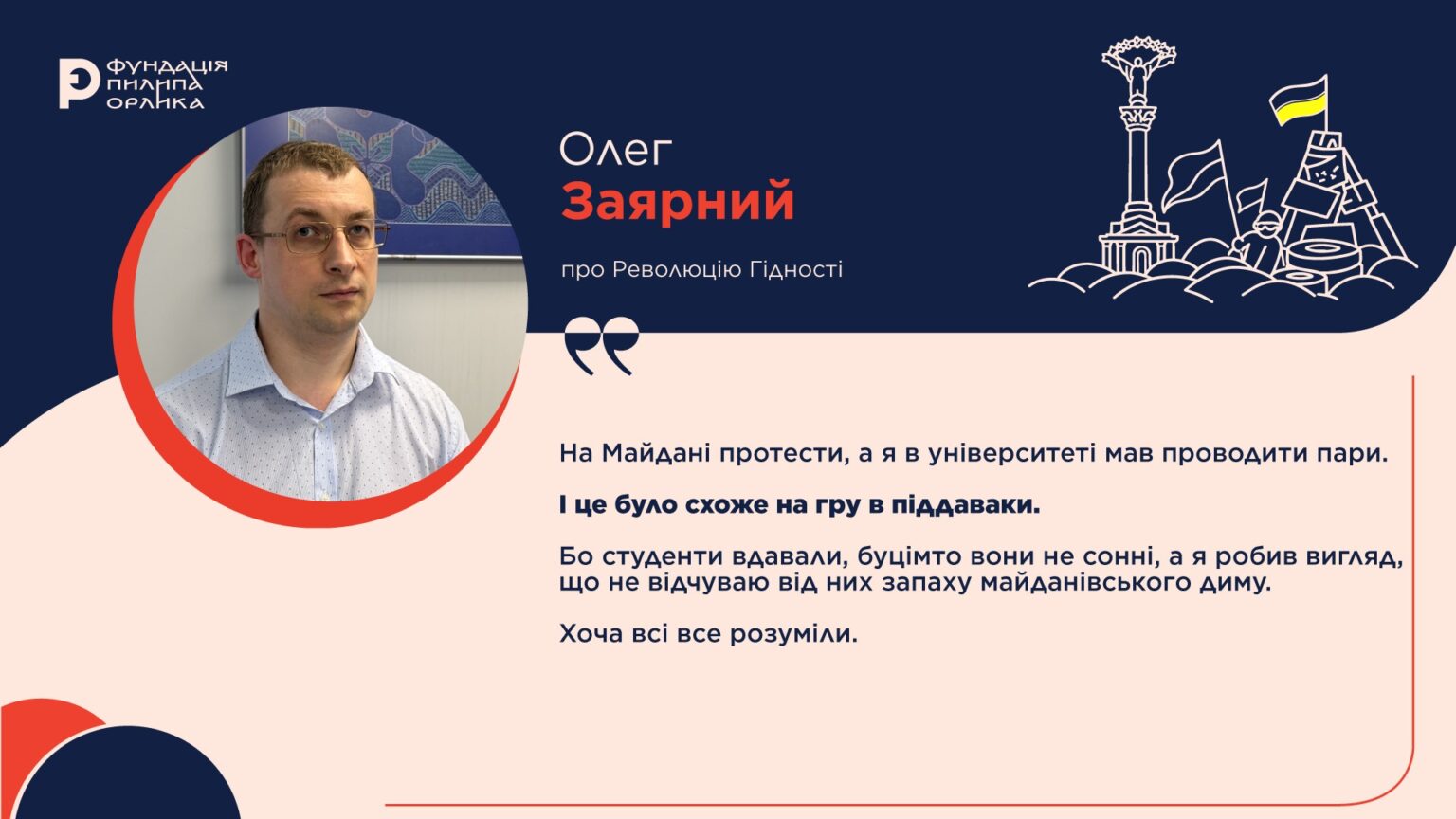
Oleh Zaiarnyi

Artem Mykolaichuk
Chairman of the Board of the Pylyp Orlyk Foundation.
Co-founder of the #unrussiaUN initiative group seeking Russia’s expulsion from the UN. Expert in building relations with European governments. Member of Ukraine’s information forces and freelance counter-propaganda consultant.
He went to the Euromaidan with his father, as he was in 11th grade at the time.
Where were you when the Revolution of Dignity began? Did you expect the protests to grow to such a scale?
The revolution found me at school, in 11th grade. My father and I went to support the protest right away. But then the square became more and more dangerous, so my father started sending me away. He stayed on his own: he supported the rallies, volunteered, helped however he could. I got there much less often.
When it all started, the thought immediately flashed through my mind that there would be large-scale events. What I didn’t expect was that a war would begin after the Euromaidan.
What from that time is most deeply etched in your memory?
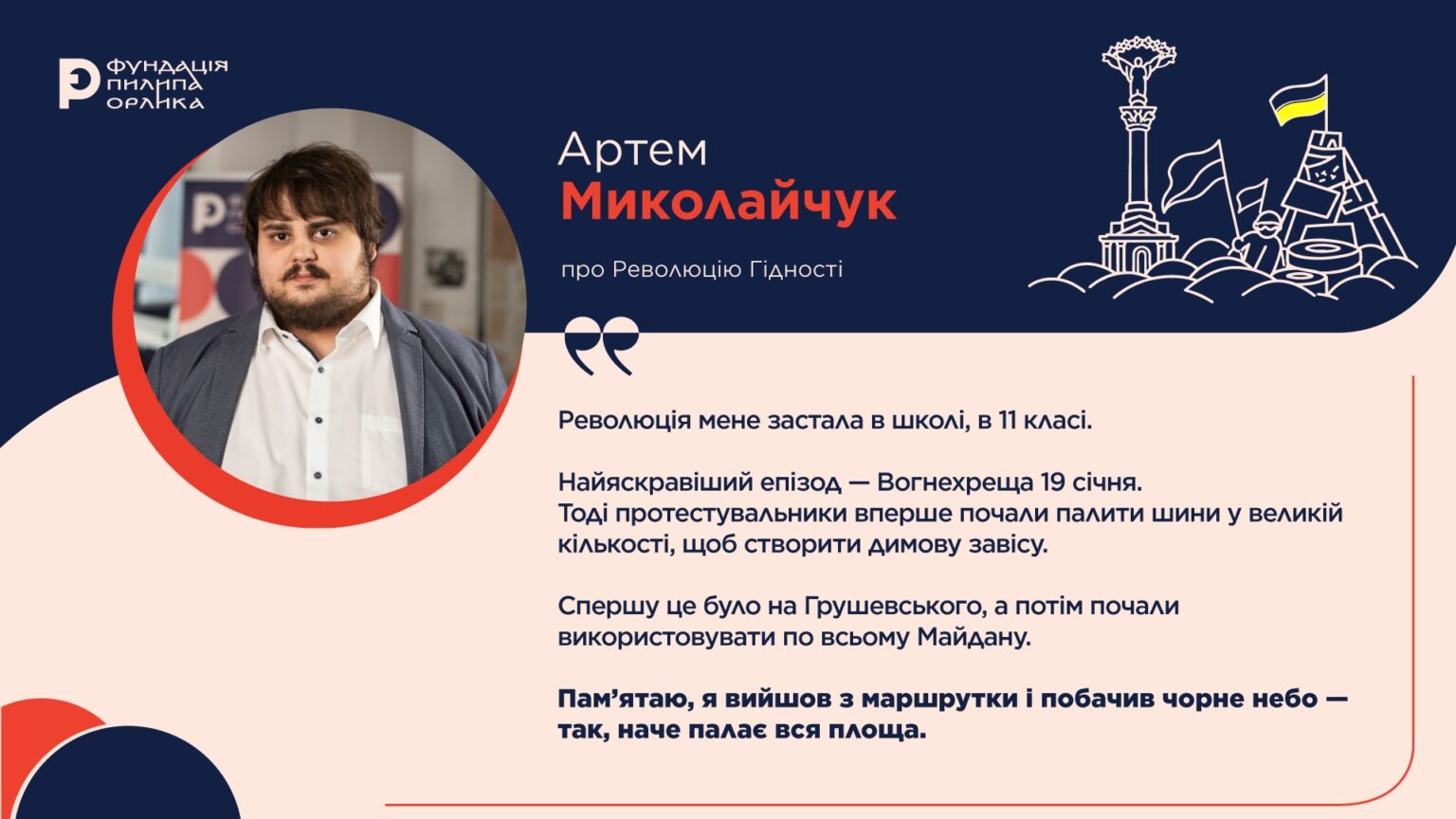
The most vivid episode is the Vohnekreshcha (Baptism by Fire) of January 19. That’s when the protesters started burning tires in large numbers to create a smoke screen. At first it was on Hrushevskoho Street, and then they started using it all over the Maidan. I remember getting off a minibus and seeing a black sky — as if the whole square was on fire.
What conclusions did you draw for yourself and/or how did the Revolution of Dignity affect you?
I realized for myself: being Ukrainian is a responsibility, not just a passport with a trident. And to be Ukrainian, you will have to fight. That is how it still goes to this day.
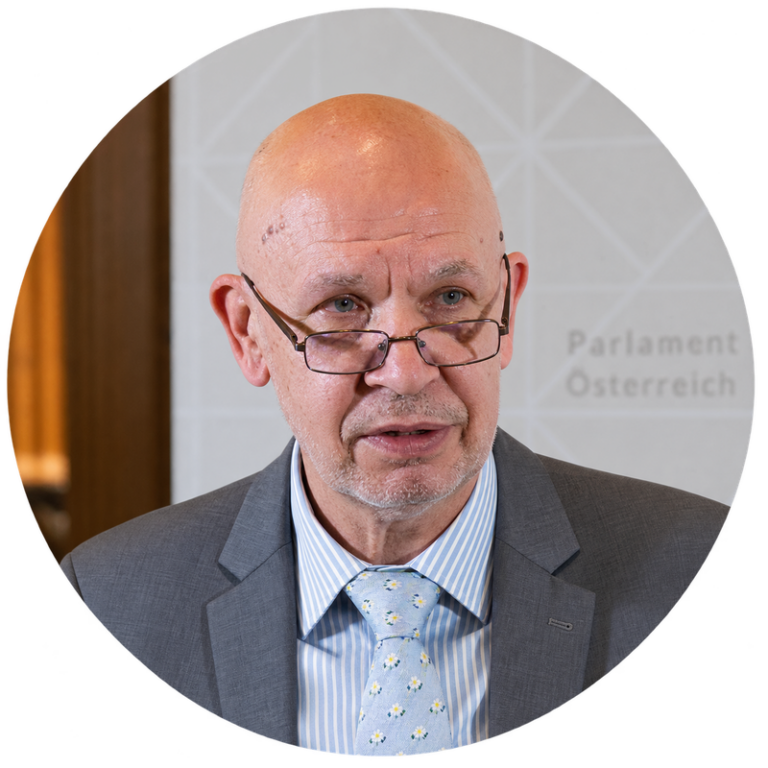
Ihor Kharchenko
Chief Consultant of the Pylyp Orlyk Foundation.
Ambassador Extraordinary and Plenipotentiary of Ukraine, PhD in History.
From January 29, 2013 to April 14, 2020, he served as Ambassador Extraordinary and Plenipotentiary of Ukraine to Japan.
Where were you when the Revolution of Dignity began? Did you expect the protests to grow to such a scale?
The revolution found me in Tokyo. The whole team was there with me. I remember calling a staff meeting.
I put two points to my colleagues then. First: all the diplomats and administrative staff read the news from the homeland and understand what is happening. And second: I simply took the text of the civil servant’s oath and read it out once more, so that everyone would understand their course of action in this situation. A state institution — the Embassy of Ukraine — must work the way it always has, regardless of what is happening at home. We worry as human beings; everyone has relatives in Ukraine they are anxious about. But the embassy must work smoothly in accordance with its internal regulations. And everyone agreed with that.
When the protesters were violently dispersed on November 30, I was already sure the protests would become massive. Because in more than 20 years of Ukraine’s restored independence, this was the first time — that children were beaten here. Ukrainians do not forgive that. I understood that this government would have to flee.
What from that time is most deeply etched in your memory?
Because of the time difference, we read the news from Ukraine, from Kyiv, at night. My mother went to the Maidan and brought pyrizhky. I remember walking to work in the morning and sometimes looking around and thinking: where am I? The events in Ukraine were still before my eyes. And it turns out — Tokyo, Japan. I had to go to work and carry out my duties as ambassador. But of course my soul and heart were in Kyiv.
And what I remember: the Japanese side tactfully decided not to interfere. Only around the third week of these events, when the clashes were taking place near the Dynamo stadium, was I invited to the Ministry of Foreign Affairs. The barricade had ended up very close to the Embassy of Japan in Kyiv. So they very politely reminded me that under the Vienna Convention, the government of the host state is responsible for the safety of diplomatic personnel working in that country. I politely bowed, confirmed that this was indeed so, and promised to pass the information on to Kyiv.
The Government of Japan held quite clearly and precisely that this was Ukraine’s internal affair. And the only thing they asked was that the staff of the Japanese embassy be safe.
What conclusions did you draw for yourself and/or how did the Revolution of Dignity affect you?
By then I was already over 50, I had drawn all my conclusions long ago. I had to do what an ambassador of Ukraine must do in the host country. First, pass on accurate information if anyone was interested. Second, act as a citizen of Ukraine born in Kyiv, where very important events were taking place.
As a civil servant, I could not publicly comment on the protests. But inside, every person understands what they want.

Anzhelika Rudnytska
Singer, artist, volunteer. Founder of the art agency “Terytoriia A”, Director General of the State Agency for the Promotion of Ukrainian Culture.
A close friend and partner of the Pylyp Orlyk Foundation.
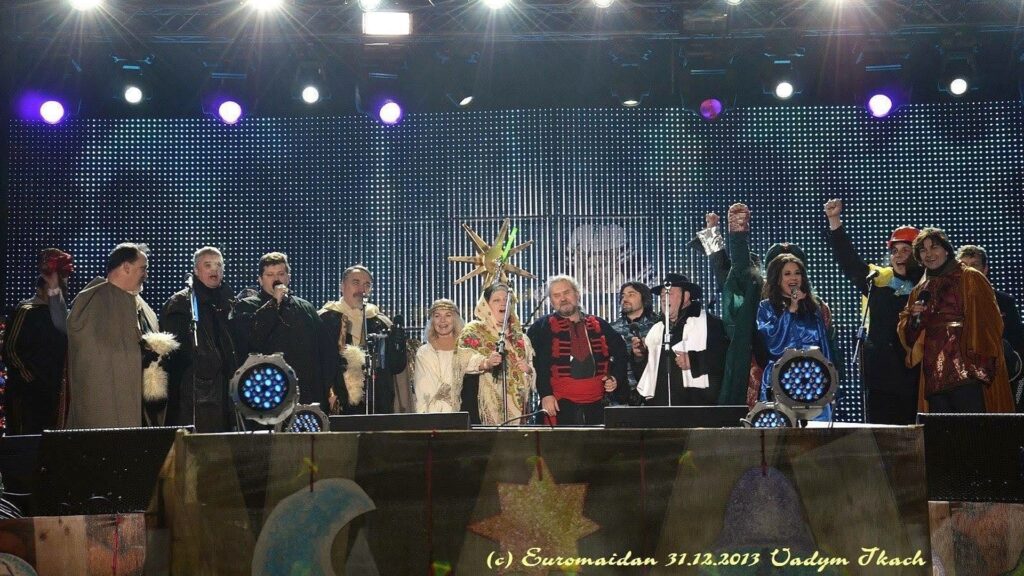
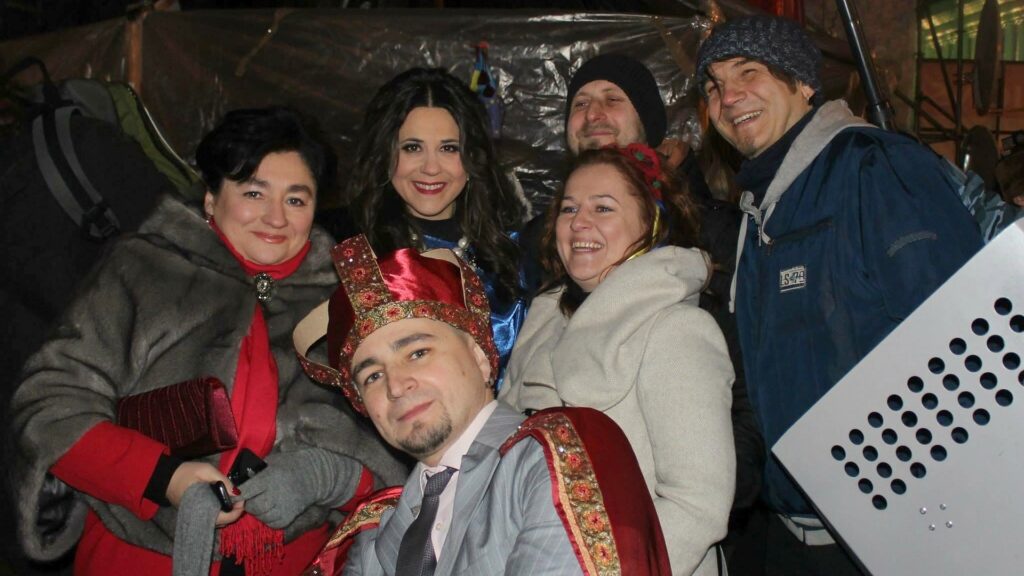
She spent all her free time on the Maidan, stepping away only for work. She performed and prepared content for the stage and the big screen near the Lobanovskyi stadium. She cleared snow, set up locations, handed out food and warm clothes. She monitored the current situation for the Self-Defense during escalations of the confrontation. She held art and educational events. She co-hosted the Euromaidan stage during the winter holidays.
After the Revolution of Dignity, she focused on military volunteering and was among the first to travel with performances to the frontline areas.
Where were you when the Revolution of Dignity began? Did you expect the protests to grow to such a scale?
As someone with two revolutions behind me, I understood very well the motivation of the students who came out to the Maidan after Yanukovych rejected European integration. At first I came to the protests to support the young people. At the same time I was working several jobs, because the revolutionary events coincided with difficulties in my family.
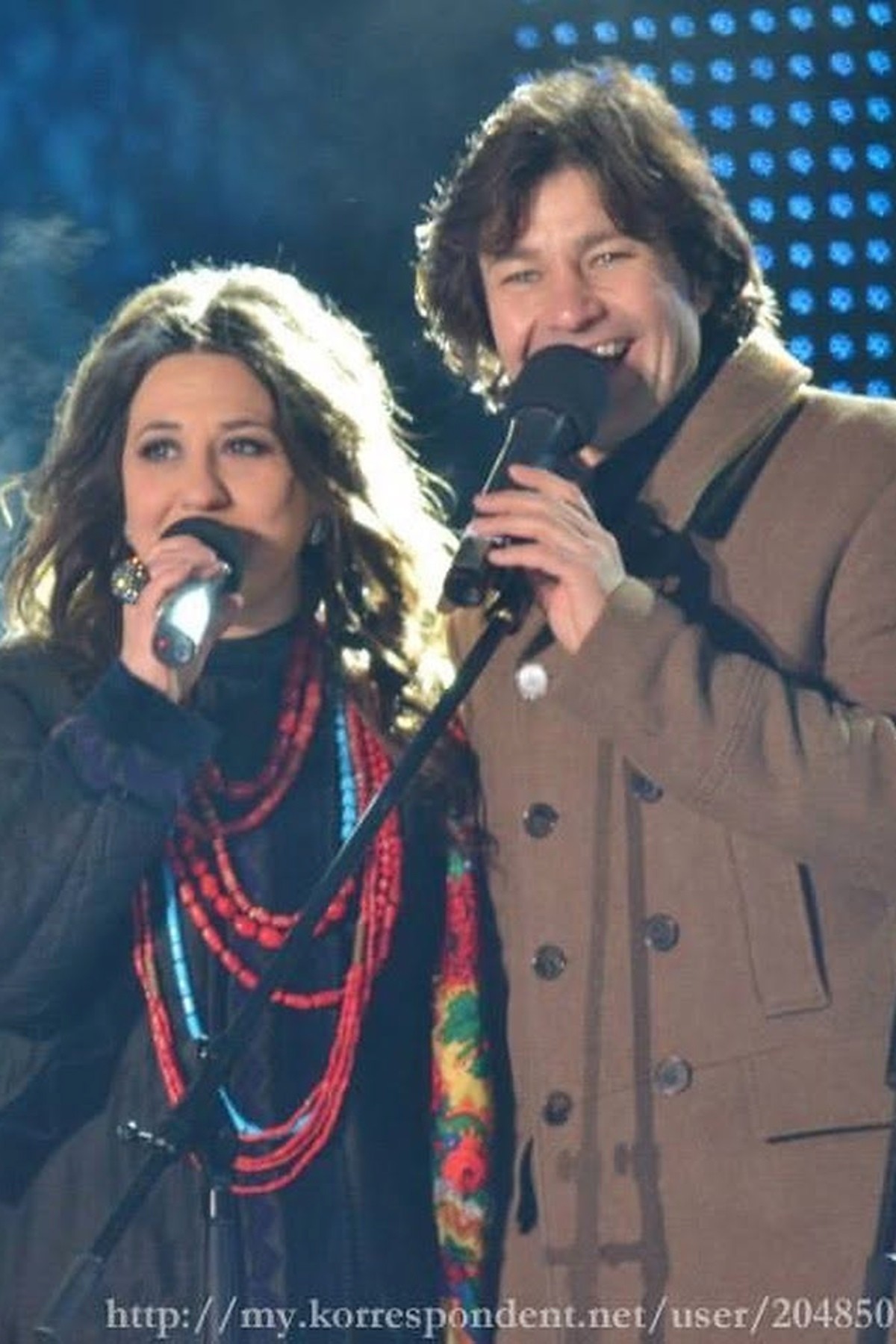
When the security forces beat the students, I was recording the program “Nekhai vam bude kolorovo” (“May Your Life Be Colorful”) at the former First National channel. The guests we had invited to the show did not arrive. But the editors and directors decided not to tell the hosts what had happened. They didn’t want to spoil our mood, because it would have shown on camera. During the recording we came up with some moves to manage without guests. When we went back to the dressing room for a break and opened our phones, we were shocked. That same night Kozak System initiated a meeting of musicians and we recorded the song “Brat za brata, svii za svoho” (“Brother for Brother, Our Own for Our Own”). It became a manifesto of Ukrainian unity. No one slept that night, and in the morning my friends and I went to Mykhailivska Square.
Intuitively, I felt right away that the protests could become massive. The authorities of the time irritated everyone, and the mood in society was already extremely tense. Most sensible people could see that we had reached the point of no return. And then the students were beaten. I was sure that a great many people would take to the streets. And that is what happened.
What from that time is most deeply etched in your memory?
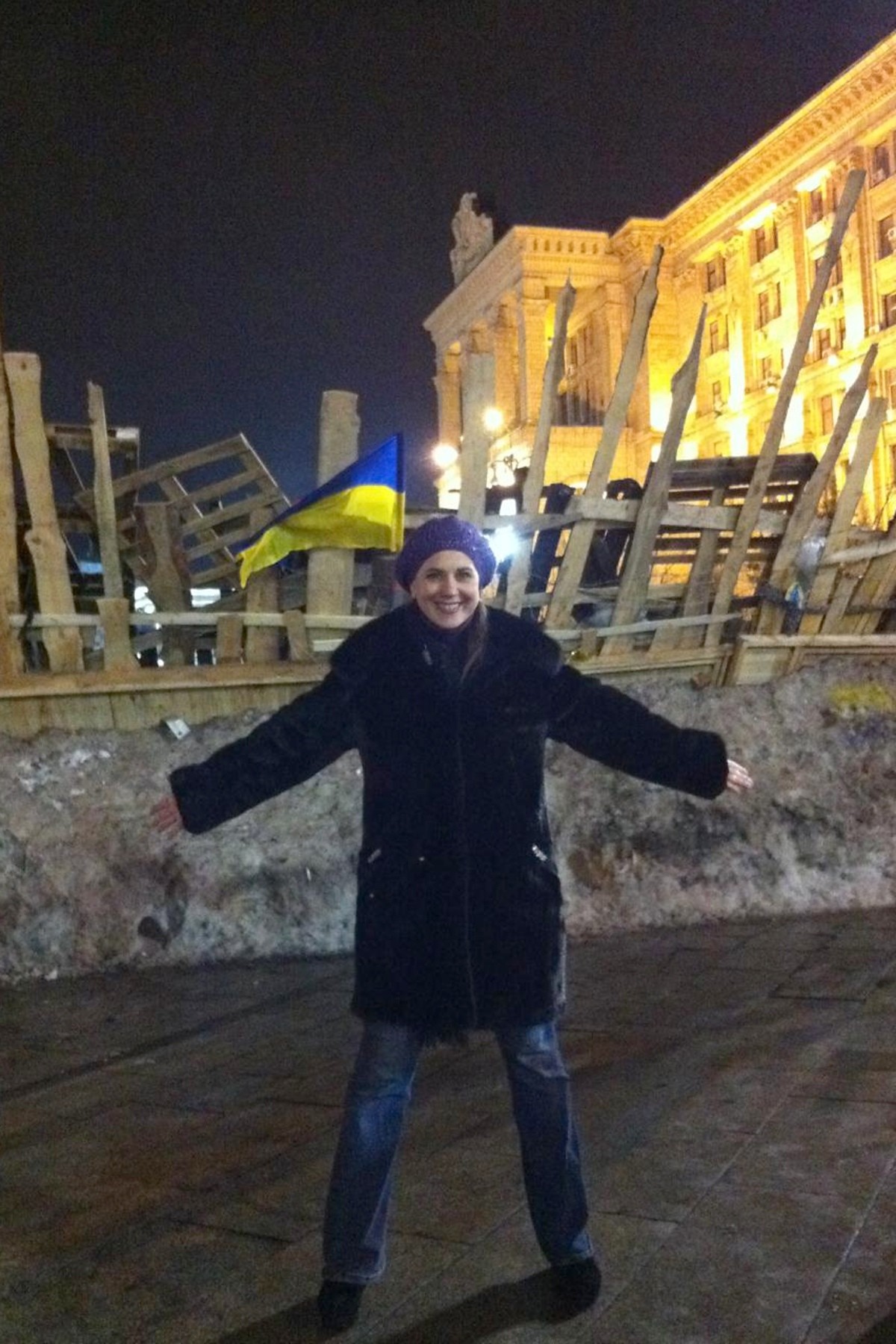
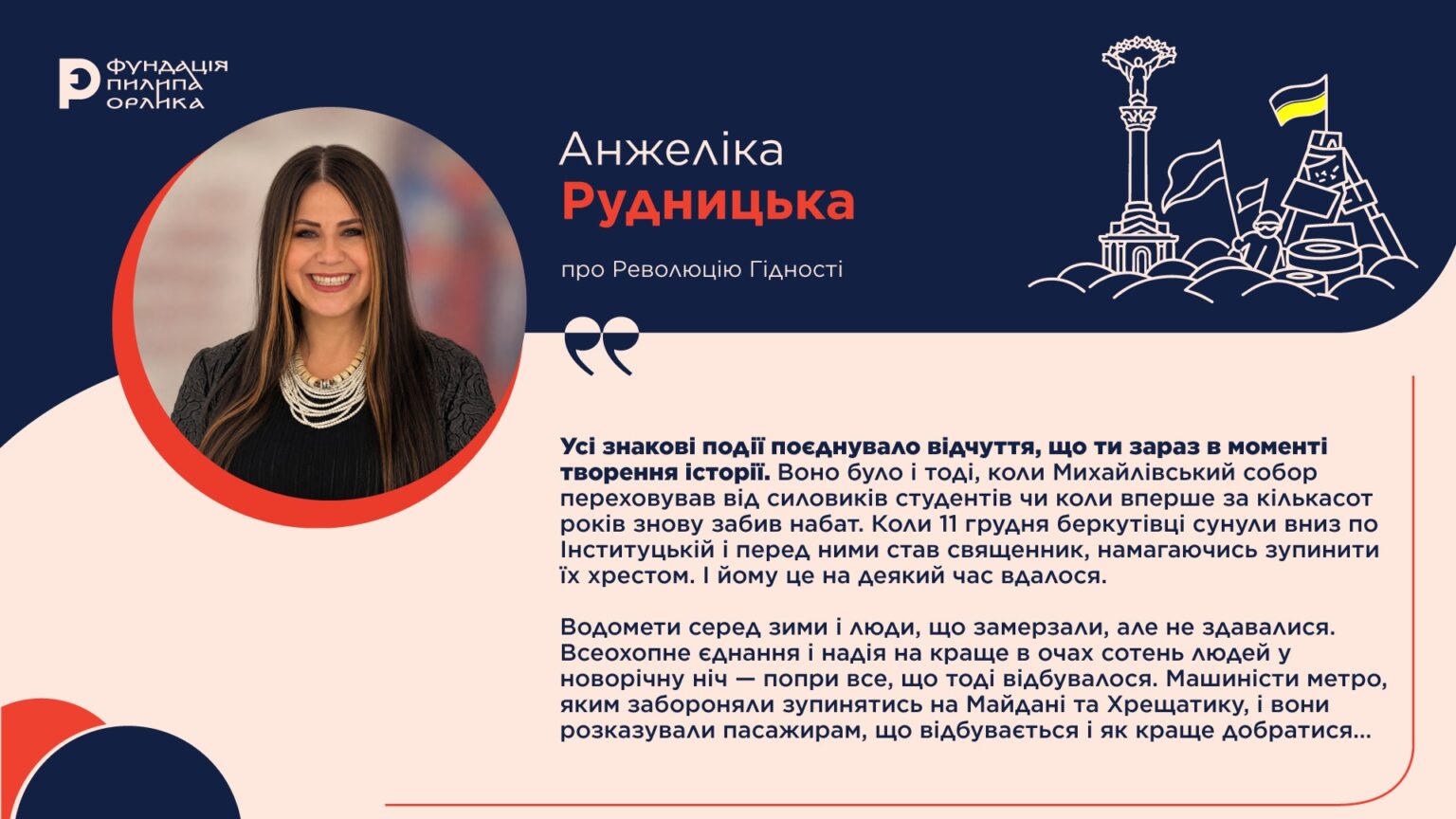
The shared emotion from a whole series of terrible or beautiful events is a sense of epoch. The feeling that you are right now in the moment of history being made. It was there when St. Michael’s Cathedral sheltered students from the security forces, or when the alarm bell rang again for the first time in several hundred years. When on December 11 the Berkut riot police advanced down Instytutska Street and a priest stood in front of them, trying to stop them with a cross and a prayer. And for a while he succeeded.
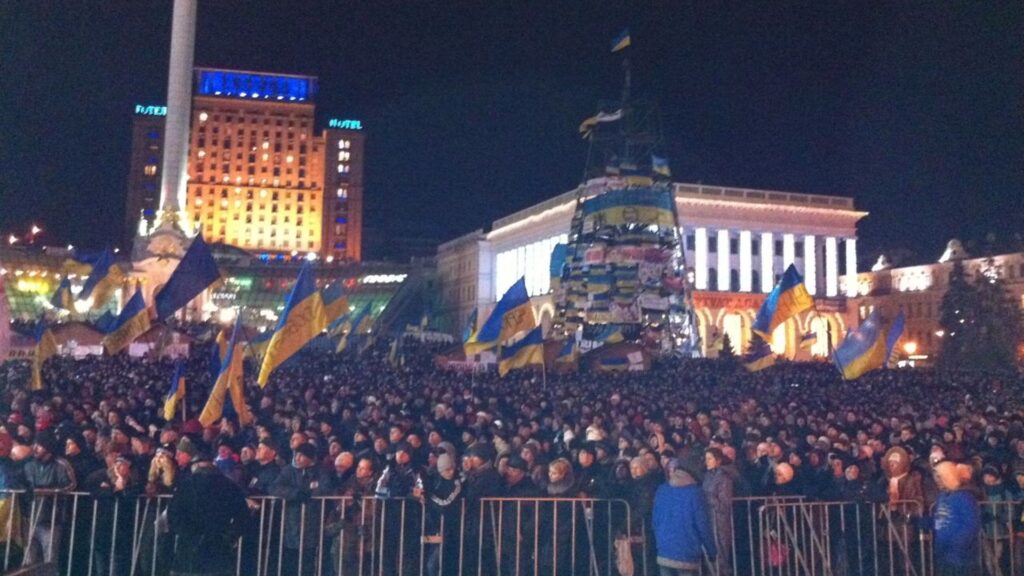
Water cannons in the middle of winter and people who were freezing but did not give up. The barricades appearing on the Maidan and the feeling that it was like a Hollywood set, but all of it was real. All-embracing unity and hope for the better in the eyes of hundreds of people on New Year’s Eve — despite everything that was happening then.
The National Anthem of Ukraine at the New Year’s Euromaidan. Anzhelika Rudnytska was a co-host. Video by Radio Svoboda.
The pain and shock from the killings of Nihoyan and Zhyznevskyi. The metro drivers who were forbidden to stop at Maidan and Khreshchatyk, and who told passengers what was happening and how best to get there.
After the shooting of the Heavenly Hundred, the coffins of those killed were seen off on the Maidan. That is the most emotionally terrible episode. I realized then that I might not notice my own tears. It was as if I wasn’t crying, but the picture went blurry. I tried to wipe my eyes and it turned out my tears were streaming like a river. I wanted to hide it somehow, I started looking around and saw that everyone around me was crying.
What conclusions did you draw for yourself and/or how did the Revolution of Dignity affect you?
I have had many revolutions and protests in my life, starting with the Revolution on Granite, which became my personal catharsis. So in 2013 the Maidan was no longer something new for me. Rather, I shared my experience and charged people with faith that the people always win. It’s just that here there was far more pain and a great deal of blood.
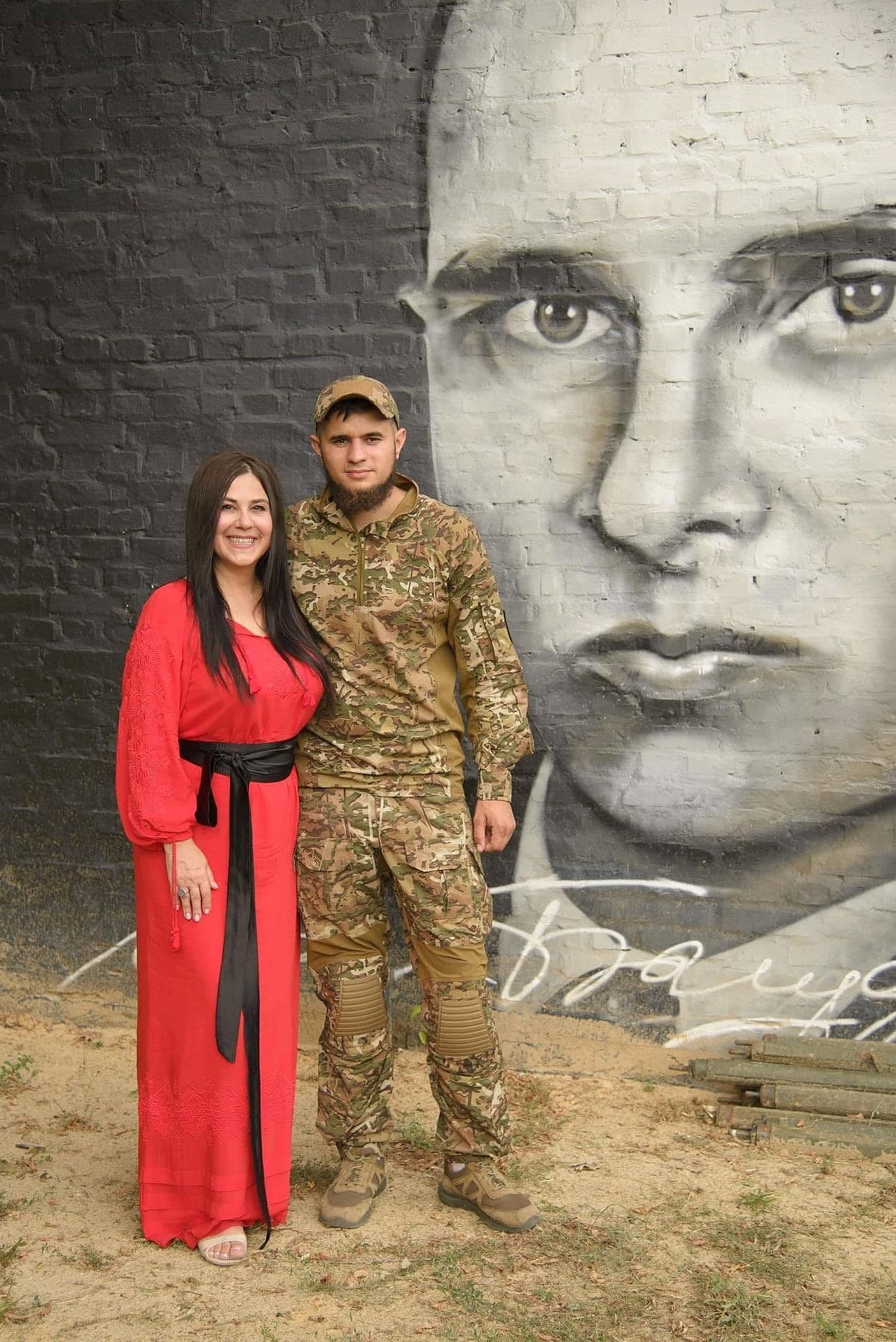
After the shootings, the phase of hybrid war began. When generation after generation lives through so many cataclysms in a single lifetime, it is simply a national catastrophe. Because our vital strength, resources and creative energy are being taken away from us. We are forced to direct all of this again and again into the struggle for everything Ukrainian, instead of recording new songs, making new albums, painting, touring with exhibitions, traveling, enjoying life.
So many people died without having had the chance to realize their potential. Dmytro Kotsiubailo, call sign Da Vinci, whom I had been friends with since the Maidan, is known as a legendary battalion commander. He went to the front at 18. But actually he was going to be an artist. And I keep thinking: God, he could have become a genius in creative work and would surely have succeeded. But he was killed by the Muscovites. My uncle, a Maidan participant, 46-year-old Oleh Mykhailov, was also killed at the front in July 2014.
This settled in me as pain. And I pack this pain down inside me and build from it a foundation for my strength. I have forbidden myself to cry. Until victory.

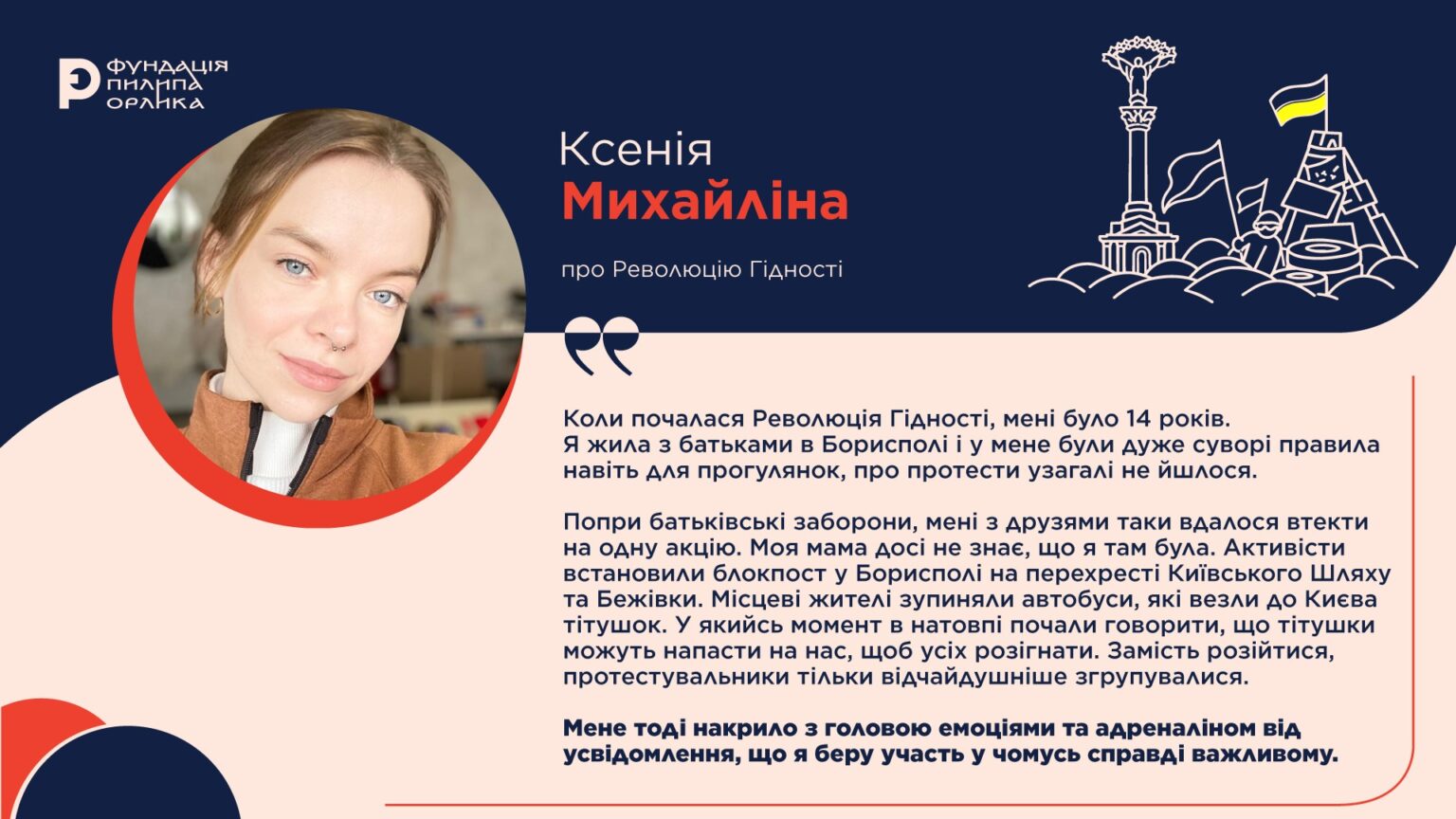
Kseniia Mykhailina
Assistant to the Chairman of the Board of the Pylyp Orlyk Foundation.
During the Revolution of Dignity, she was a schoolgirl and, together with her peers, went to protest actions secretly from her parents.
Today she volunteers for the Ukrainian army, works on pro-Ukrainian projects and, after everything the country has been through, has a clear civic position.
Where were you when the Revolution of Dignity began? Did you expect the protests to grow to such a scale?
When the Revolution of Dignity began, I was 14. I lived with my parents in Boryspil. Because of my age, I did not take part in the events on the Maidan in Kyiv. Besides, my parents had fairly strict rules about going out, and when the protests started they became even stricter. So I supported the protesters as much as a teenager could. I knew the reasons for the protests and clearly understood: I don’t want Ukraine to move closer to Russia instead of the European Union. My father still held a pro-Russian position then, so I am proud that my own views remained unchanged despite the pressure in the family.
I remember well how we discussed those events with my classmates in a special history course. We couldn’t understand why there were people at all who wanted Ukraine to remain under Russia’s influence instead of association with the European Union. I didn’t expect the confrontation to last so long, let alone reach such a scale. In the same way, to be honest, even on the eve of the full-scale invasion I didn’t believe it would really happen.
What from that time is most deeply etched in your memory?
Despite my parents’ bans, once my friends and I did manage to sneak off to a protest. My mother still doesn’t know I was there. Activists set up a checkpoint in Boryspil at the intersection of Kyivskyi Shliakh and Bezhivka. Local residents were stopping buses carrying titushky to Kyiv. At some point people in the crowd started saying that the titushky might attack us to disperse everyone.
Instead of dispersing, the protesters only grouped together more desperately. I was completely overwhelmed then by emotions and adrenaline from realizing that I was taking part in something truly important, defending the Euromaidan together with everyone, and that this matched my values. On the one hand, I really liked that feeling of belonging and significance. On the other, I understood: if my father found out I was here, I’d be in big trouble. Everything went fine and I came home. But I am grateful to myself and my friends that we did dare to go there.
What conclusions did you draw for yourself and/or how did the Revolution of Dignity affect you?
Above all, the Revolution showed me how amazing our people are. That people can unite on such a mass scale and defend their values. Although it sounds a bit too grandiose, we really are unbreakable, and no Yanukovyches, Azarovs or Putins can dictate the rules to us.
For me personally, an important and very difficult lesson of that period was understanding that my position must be a priority and that I must stand up for it. And the views of other people, even those closest to me, in no way determine who I am and what place I occupy in society.
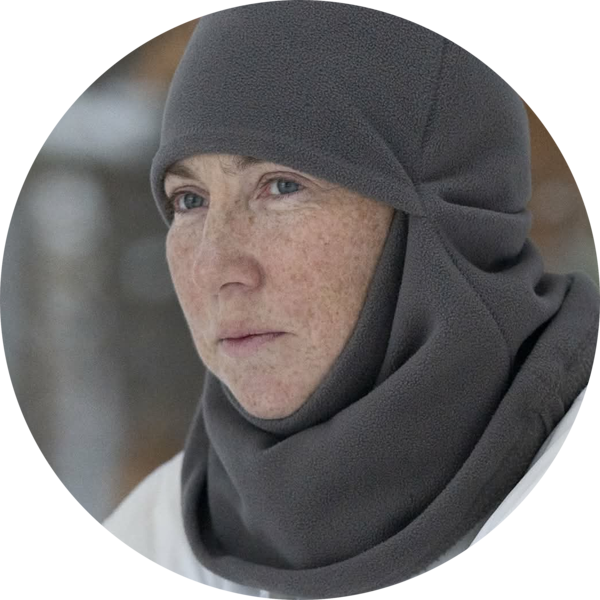
Kateryna Maksym
Serviceman of the Armed Forces of Ukraine. A close friend and partner of the Pylyp Orlyk Foundation.
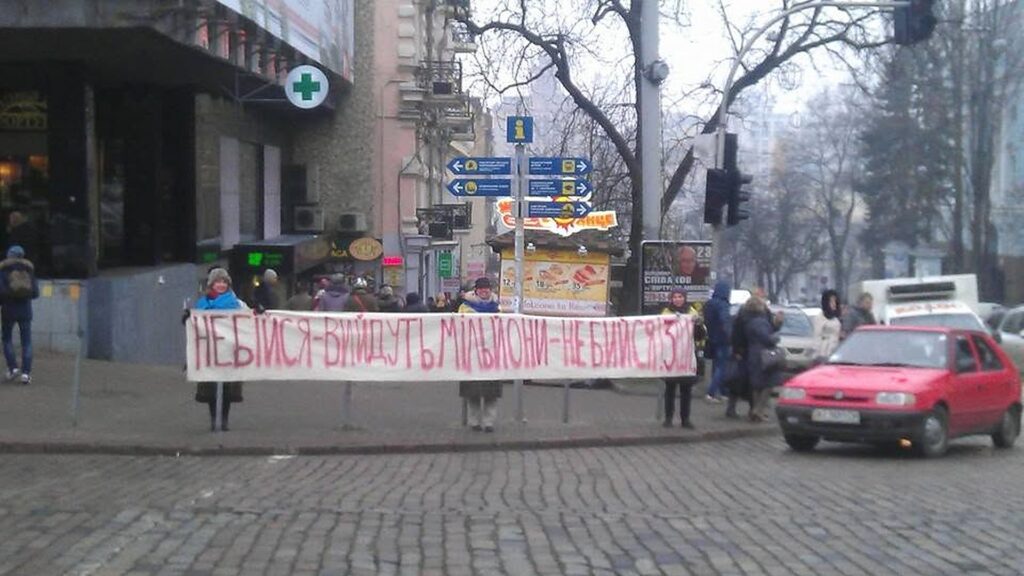
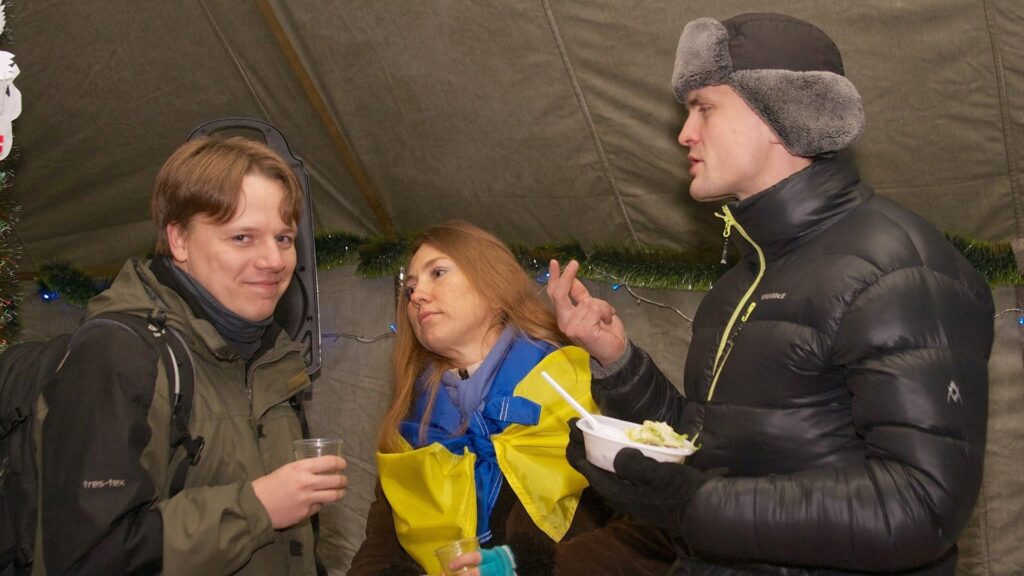
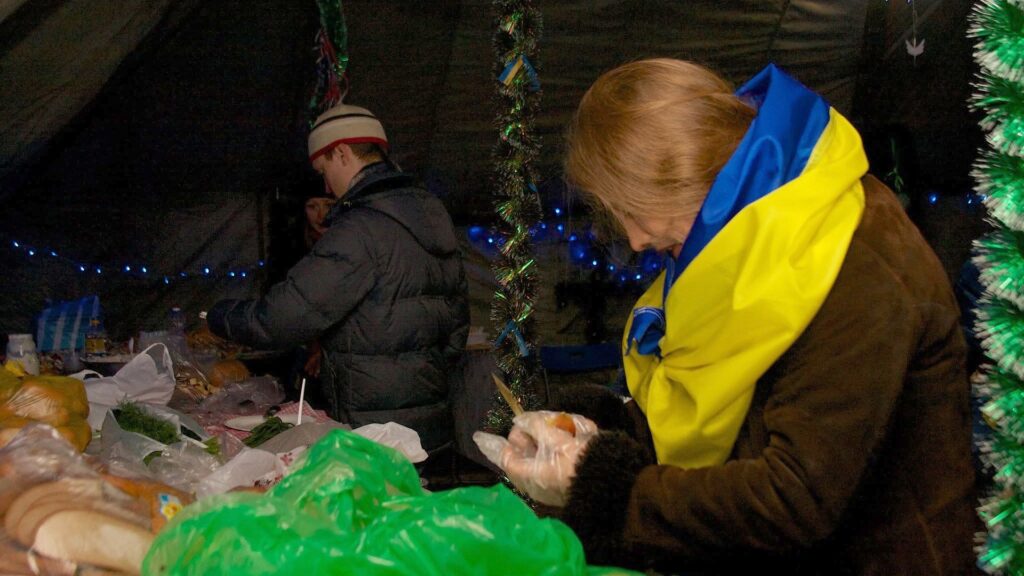
Before the Revolution of Dignity, she held senior positions in marketing companies. She was a member of the Euromaidan Civic Sector. She organized the debunking of Russian fakes and support for foreign journalists. After the revolution, she focused on projects that contributed to Ukraine’s development, especially in education. At the start of the full-scale invasion she volunteered, and in 2023 she joined the Armed Forces of Ukraine.
Where were you when the Revolution of Dignity began?
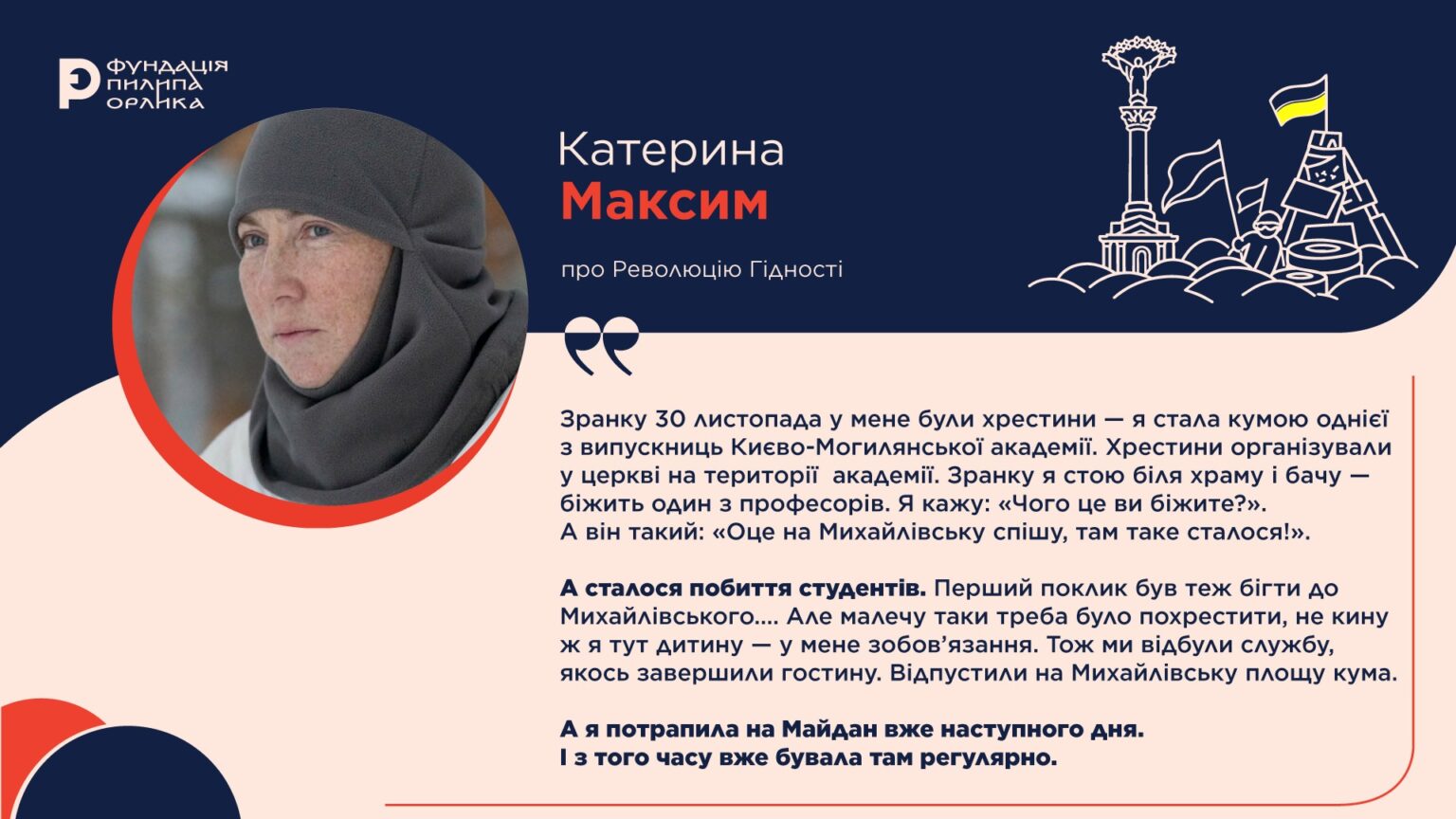
When the revolution started, I followed the protests a little, but at the level of supporting the students. At that time it seemed that I had already done my share of revolutions and now it was the younger generation’s turn. On the morning of November 30 I had a christening — I became godmother to the child of a graduate of the Kyiv-Mohyla Academy. We both came from that milieu. The christening was held in the church on the academy grounds. In the morning I am standing by the church and I see one of the professors running. I say: “Why are you running?” And he says: “I’m hurrying to Mykhailivska, something terrible has happened there!” What had happened was the beating of the students. My first impulse was to run to Mykhailivska too… But the little one still had to be christened, I couldn’t just abandon the child here — I had an obligation. So we held the service and somehow wrapped up the reception. We let the godfather go to Mykhailivska Square. And I got to the Maidan the very next day. And from then on I was there regularly.
What from that time is most deeply etched in your memory?
Already during the revolution I had to fly to Italy to talk with partners I had once wanted to bring in to invest in Ukraine, and now I had to warn them not to rush. Marketing faded into the background. It was December. On the plane I picked up some reputable English-language publication to read, I no longer remember its name. And there the authors write in all seriousness that Nazis have gathered on the Maidan and are trying to destabilize the situation in Ukraine. I realized that something urgently had to be done about this.
After returning to Kyiv, together with the American Vivitsa Williams I launched the Euromaidan Civic Sector News Digest. We translated truthful information about the state of affairs in Ukraine into English. I was also asked to organize translators who spoke different languages and wanted to be useful (eventually as many as 46 of them gathered). There was demand for the offer — they worked with foreign journalists who were to cover the events in Ukraine.
There were almost stalemate situations, when two TV crew members from a leading Italian channel arrived with the firm intention of getting a spectacular picture of Maidan protesters beating the police. The request was biased, but we decided not to refuse. First we took them around the Maidan and showed them that the activists were not attacking the police. The Italians weren’t interested in anything else. We sat down and thought. At that time there was one very popular beautiful girl on the Maidan, a blonde, who told why she had come to the barricades, and this confession went viral. We offered her to the Italians. They liked it: oh, a pretty girl, a delicate blonde, against the backdrop of the barricades. Then we found another model, a “Miss Ukraine”, who was also on the Maidan. So the Italians listened to our girls and, instead of the expected picture of violence, took these stories home. And as it happened, there were no violent clashes during their visit.
Another story was with independent journalists who, on the contrary, came during a period of escalation, but they weren’t interested in beatings — they wanted to film everyday life. We took them to different locations, and this grew into the portrait-story project “The Fighters of Maidan”. A person, their photo and their story: what they did before the revolution and how they joined the Self-Defense. Al Jazeera later published this series of photographs. Behind the beautiful photos was risky work, because the security forces were already shooting at people, and the journalists were trying to get closer to take a spectacular shot. I remember my heart sank at the thought that an international photographer I was personally responsible for could be killed. He himself, it seems, didn’t understand the danger or why I was shouting so loudly to get him out of there. And the Berkut were already starting to regroup and take aim; I was very nervous.
What conclusions did you draw for yourself and/or how did the Revolution of Dignity affect you?
The hardest question is how the Revolution of Dignity affected me after the umpteenth protest movement in my life. I became firmly convinced that a revolution cannot be won once and for all. You have to be ready to go out again in X years. Freedom loves to be fought for, as Volodymyr Viatrovych said.
And my priorities finally changed. Even before the Maidan I had stepped back from business for a year. I was planning to change the format somehow, to open my own business. I felt some oppressive tension, as if something was coming. I distracted myself with painting. My intuition didn’t let me down. After the Revolution of Dignity, my career faded into the background. I went into fields where the conditions weren’t always advantageous, but where I could invest myself in Ukraine’s development, especially in education. After that I joined a project of environmental protection reforms. And, accordingly, with the start of the full-scale war I switched completely to defending the country.
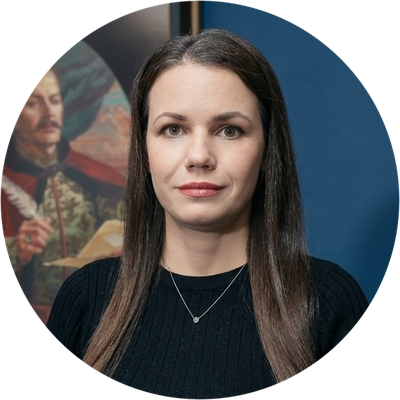
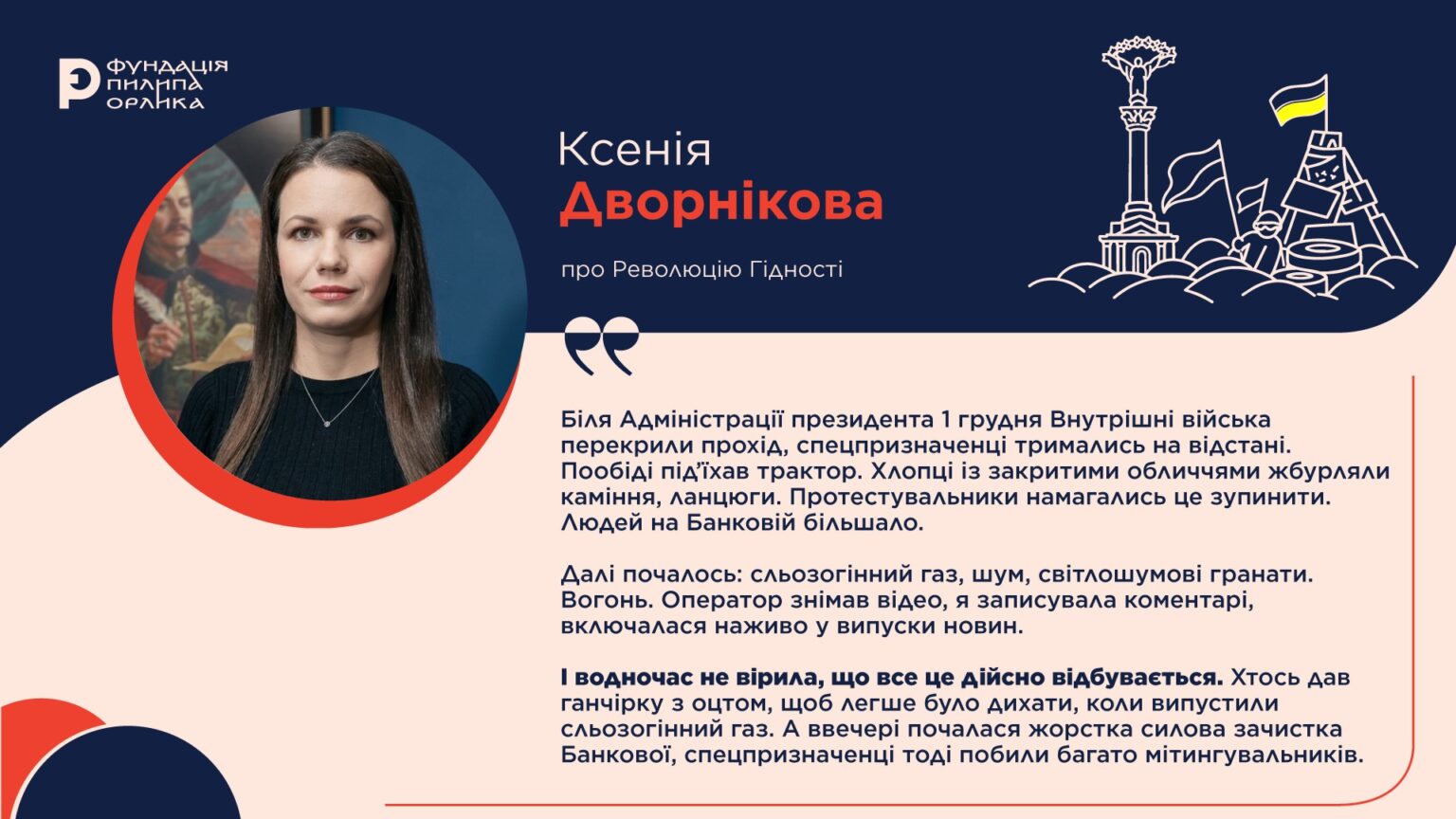
Kseniia Dvornikova
Head of Communications and Public Relations at the Pylyp Orlyk Foundation. Host at Ukrainian Radio, journalist, author of books about the Russian-Ukrainian war “Surviving in Hostomel: 21 Stories from a Hero City” and “Artists at War: Stories about Art and Choice”. In 2021–2024 she headed the Development and Communications Department of the National Museum of the Revolution of Dignity.
During the Revolution of Dignity, she worked as a journalist and presenter at Channel 5 and covered the protests.
Where were you when the Revolution of Dignity began? Did you expect the protests to grow to such a scale?
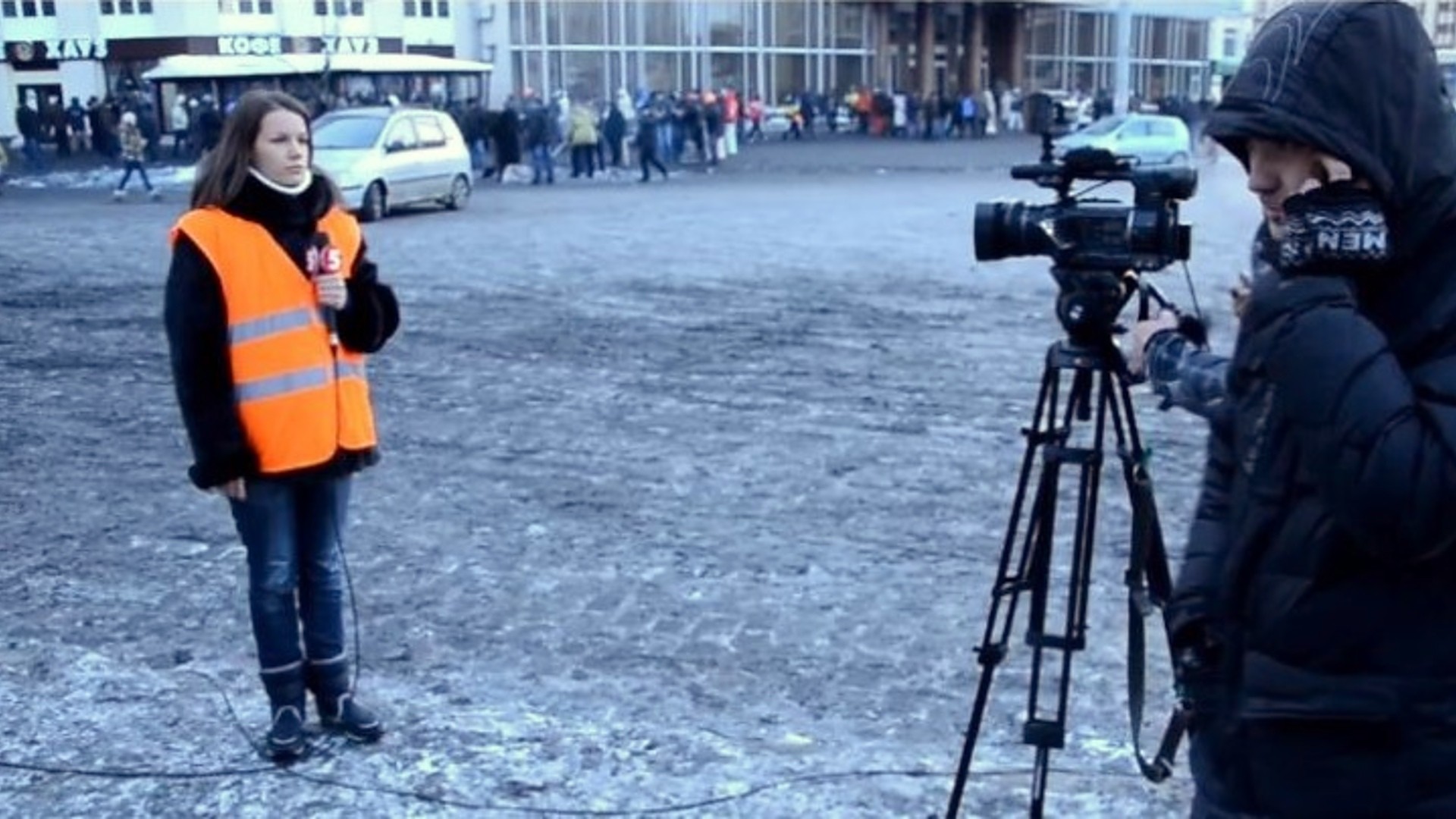
On the eve of the events that would later go down in history as the Revolution of Dignity, I returned from a holiday in Barcelona. Those were happy, warm autumn days when it seemed the Association Agreement was about to be signed… But in Ukraine I was met by a sharp change in temperatures — both climatic and political. On the morning of November 21 I felt I had fallen ill, and in the afternoon the Azarov government issued a statement which made it clear that Ukraine might not sign the Association Agreement — the process was being suspended.
And in the evening people began to gather on the Maidan, among them many of my friends and colleagues. At that time I could only watch Channel 5’s live reports and at least stay informed that way. Later I was on the Maidan myself, covering the protests from the very first days.
If in November the protests had one dynamic, then on December 1, after the Berkut beat the demonstrators, the situation changed radically. Back then I couldn’t even imagine that ahead lay rallies of many thousands, the storming of the tent camp by the security forces, burning barricades on Hrushevskoho Street, the shooting of Maidan protesters on Instytutska Street, the occupation of Crimea, the Russian-Ukrainian war…
Recall one moment from that time that has stayed in your memory
It was my day off. And on December 1, 2013 I came to Khreshchatyk thinking — I’ll be a participant in the protests. But things turned out so that I unexpectedly worked as a journalist. It was the first truly massive protest, which gathered in response to the beating and dispersal of demonstrators on the night of November 30. The protesters tore down the fencing around “Yanukovych’s yolka”, and started putting up tents. On Bankova Street near the Presidential Administration, the Internal Troops blocked the way, with the special forces standing a little further off. I saw a tractor drive up in the afternoon, saw guys with covered faces hurling stones and chains. Saw protesters, among them many people I knew, trying to stop it. There were more and more people on Bankova. It was getting louder and louder there. Time was compressing.
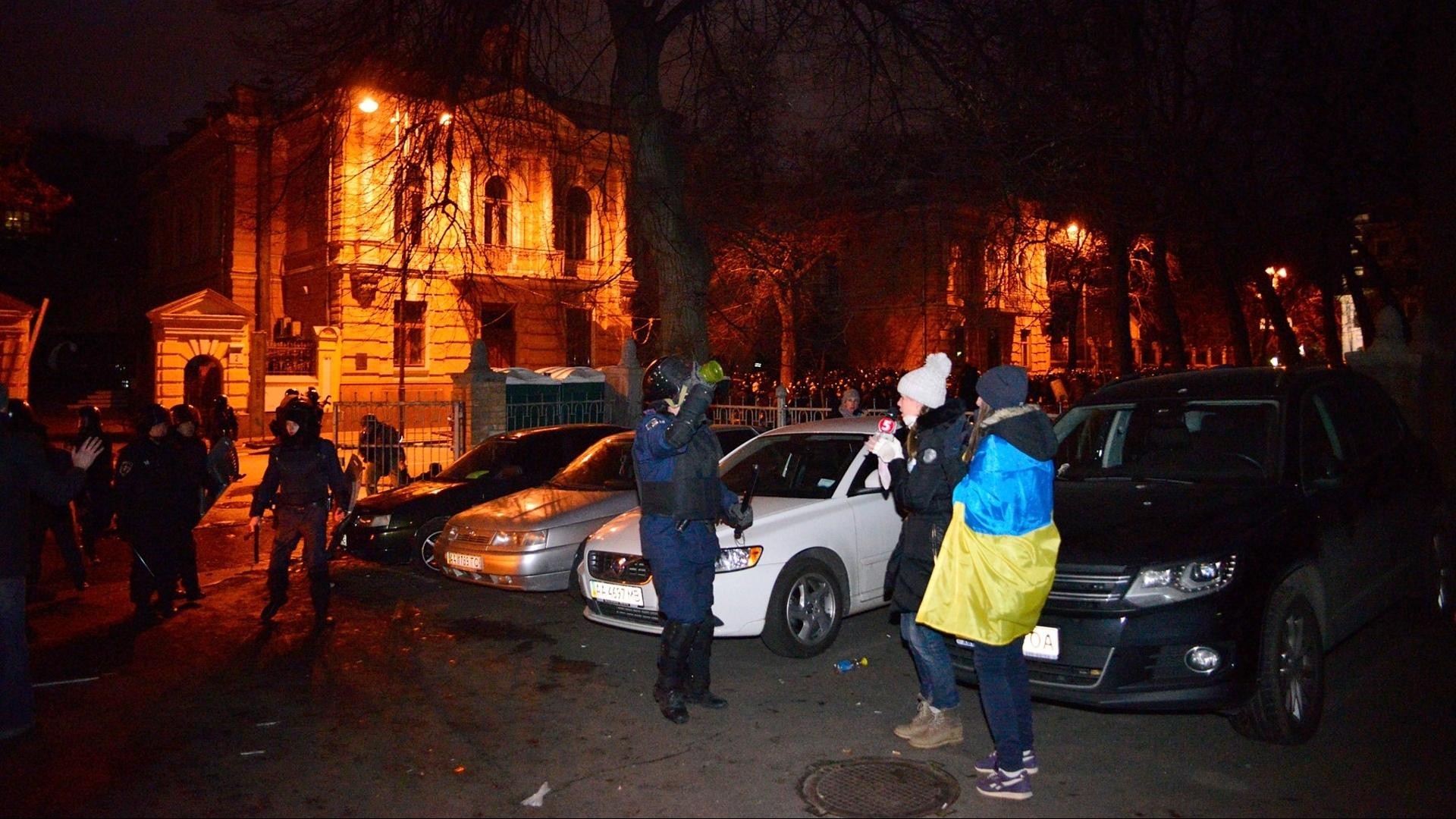
And it began: tear gas, noise, stun grenades. Fire. The cameraman was shooting video, I was recording comments and going live in the news broadcasts. And at the same time I couldn’t believe that all this was really happening. Someone gave me a rag soaked in vinegar to make it easier to breathe when the tear gas was released… And in the evening a brutal forceful clearing of Bankova began; the special forces beat many demonstrators then.
What conclusions did you draw for yourself and/or how did the Revolution of Dignity affect you?
Choice defines a person. It shows who you are, what you believe in and which values really matter to you. And both choice and the illusion of “no choice” have their price.
The enemy is strong, but not invincible. The struggle is long and difficult. And it still goes on. Freedom and dignity come at an incredibly high price. And it’s not about money.
The memory of people, their decisions and events is priceless.
And you need to learn tactical medicine, hoping you will never have to use that knowledge.
Kseniia Dvornikova reporting live from the protests on Hrushevskoho Street for Channel 5 news.
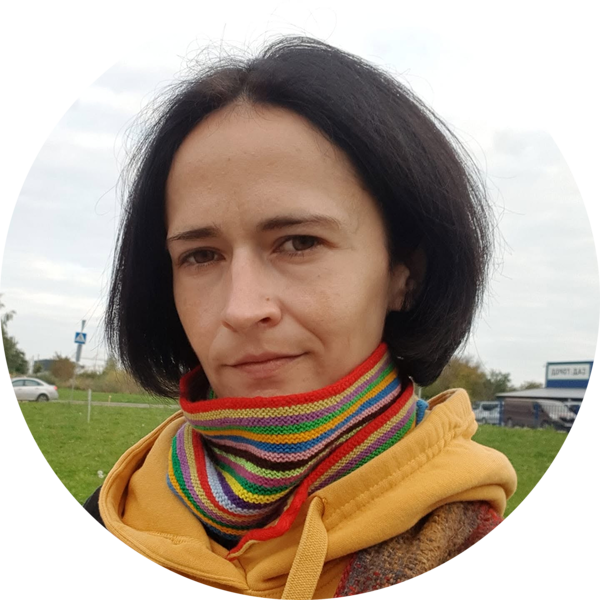
Vasylyna Duman
Communications specialist at the Pylyp Orlyk Foundation.
Freelance journalist, cultural studies scholar.
During the Revolution of Dignity, she created the creative department in the Euromaidan Civic Sector. Author of the idea of the “Euromaidan is…” candy wrappers and the revolutionary valentines.
Where were you when the Revolution of Dignity began? Did you expect the protests to grow to such a scale?
At that time I lived in Lviv and was finishing my master’s in journalism. At first, like many of my peers, I regarded the protests as a task for the next generation. As in, I had done my share of fighting in the Orange Revolution. Back then I was convinced that wherever possible, they would manage without me. On the contrary, I went to actions that weren’t crowded. For example, to a picket of the police after Vradiivka. Society was already electrified then, but I felt it wasn’t enough for a revolution.
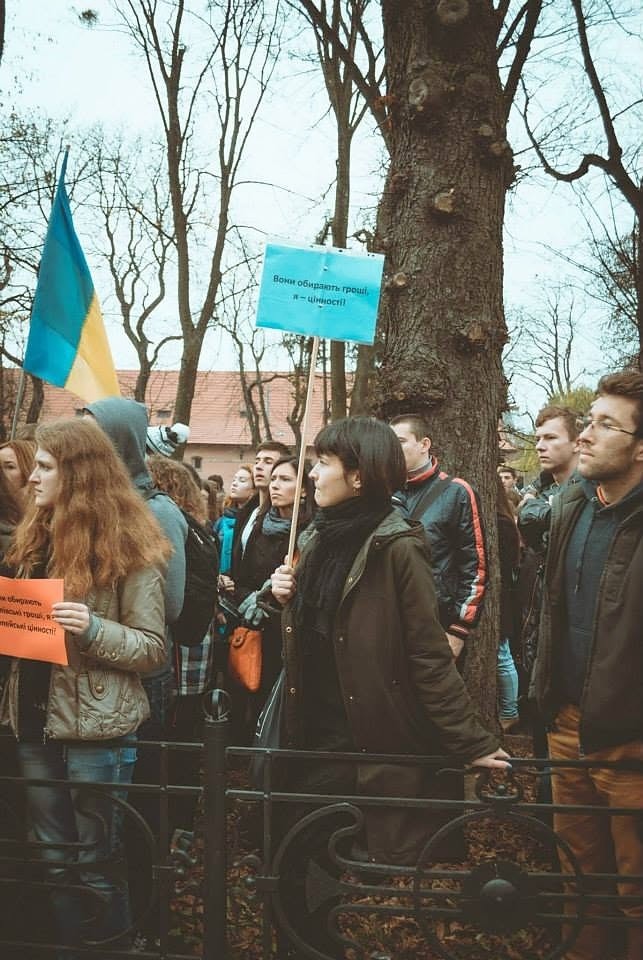
On the evening of November 21, when journalists and students came out to the Maidan in Kyiv, young people in Lviv went to their own. I, honestly, was too lazy to go anywhere. A student rally was announced for the morning of the 22nd, and I decided to go and have a look. It was massive. But the atmosphere had changed too.
If during the anti-police riots in Vradiivka I felt that nothing would come of it, here I understood clearly: it has begun. From then on I threw myself headlong into the affairs of the Euromaidan. At first I helped the Lviv press service, and a few days later I went to Kyiv.
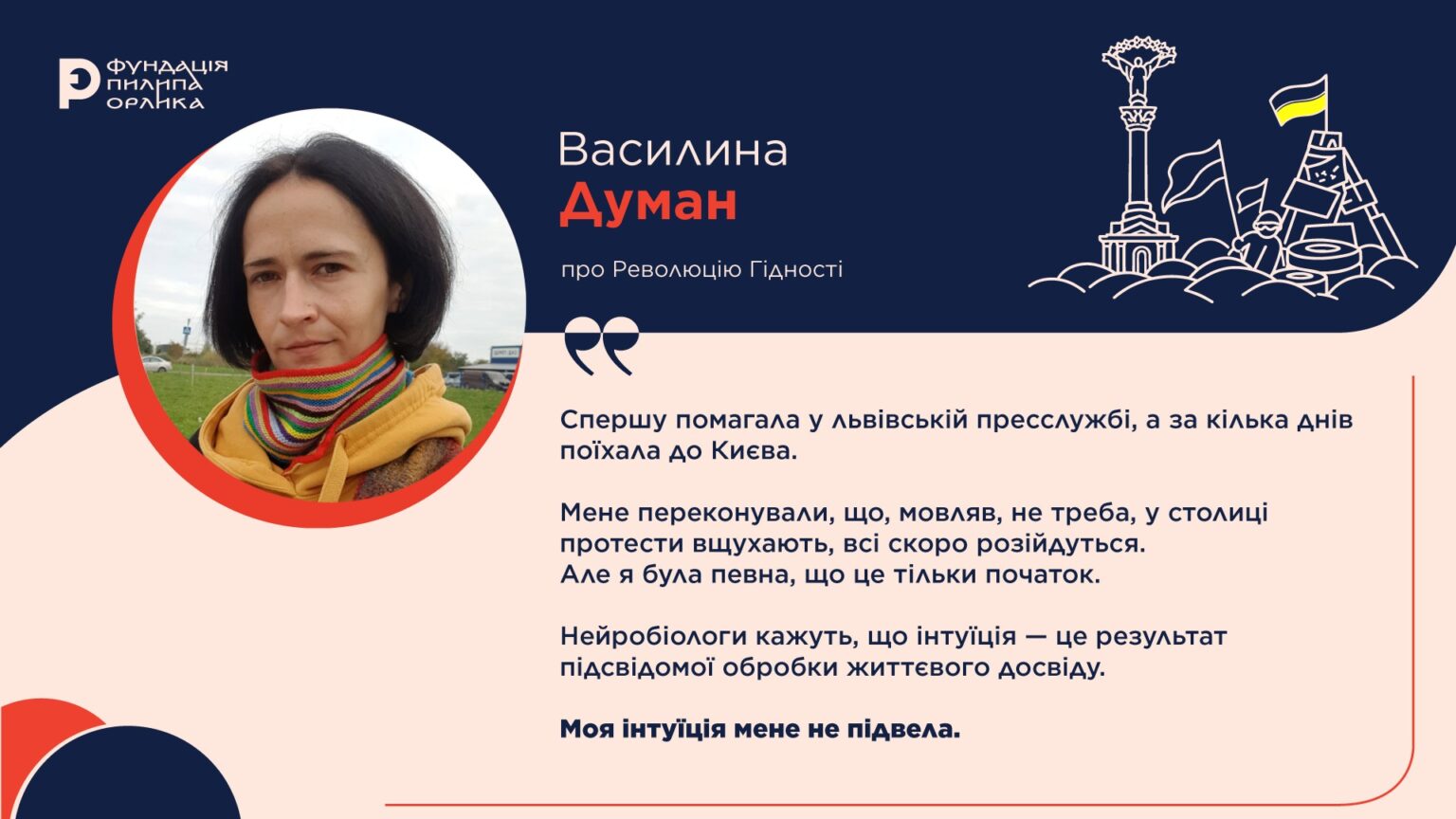
People tried to convince me that there was no need, that the protests in the capital were dying down and everyone would soon go home. But I was sure this was only the beginning. Neuroscientists say that intuition is the result of the subconscious processing of life experience. My intuition did not let me down.
What from that time is most deeply etched in your memory?
Several times I miraculously avoided the threat of being beaten.
On the night of November 30 I stayed late on the Maidan. I was helping new friends from the Civic Sector find accommodation for people. Everything was simple, as always at revolutions: “Hi. Who are you? I’m Vasia. And I’m Katia. What are we doing? Well, we’re finding places for newcomers and registering Kyivans who are ready to put them up. Will you help? Sure.” Five minutes and you’re already an accommodation coordinator.
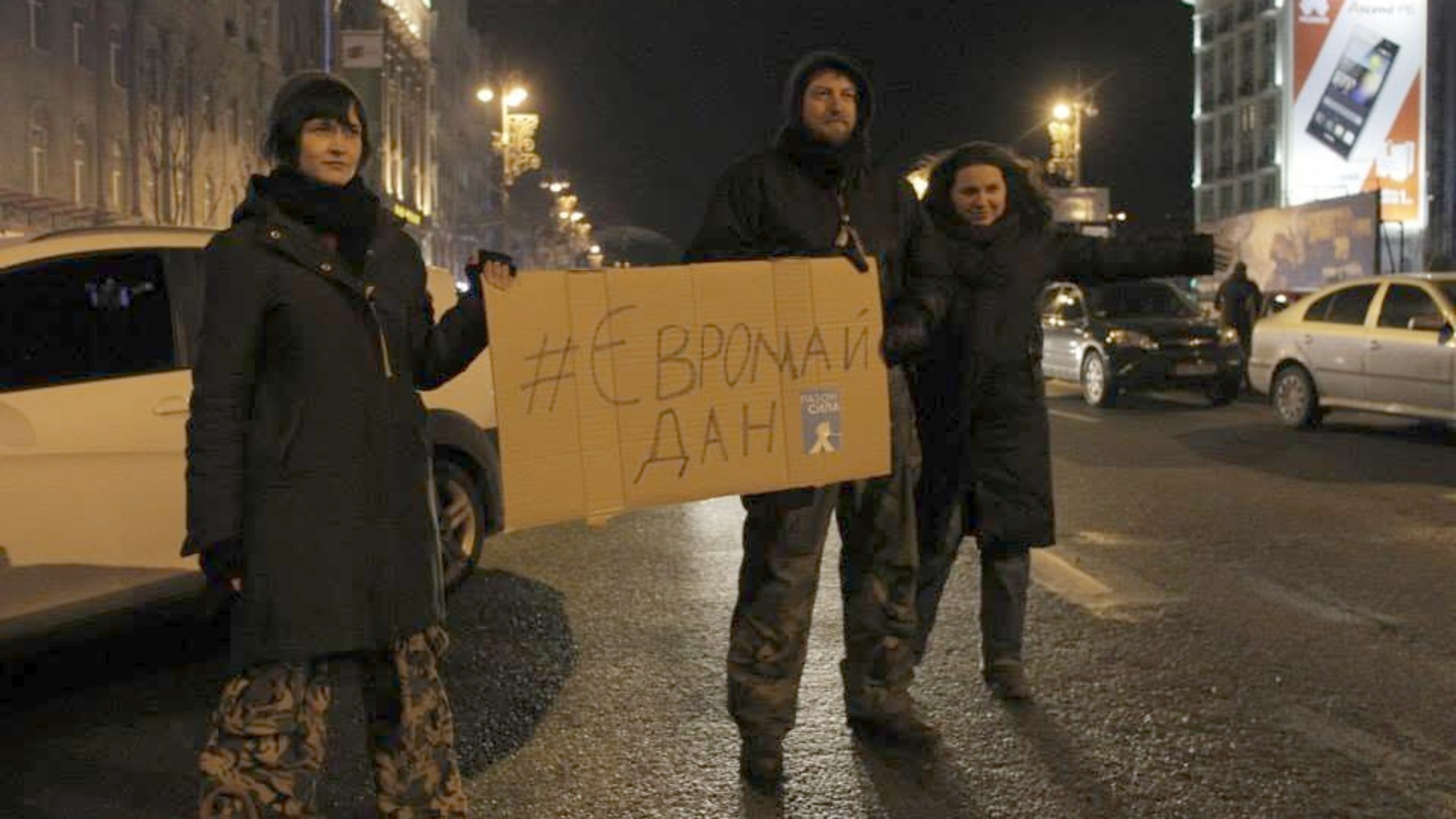
We met the new arrivals under the stela, then moved to a café nearby. Then I got tired and went to sleep. As it turned out, 20 minutes later the security forces beat the protesters. And my friends were frantically looking for me until morning, because I had gone to sleep at the “Vidsich” movement’s place, and there was a basement with no phone signal.
On December 1, the authorities had enraged the Ukrainian people so much that, by various estimates, from 500,000 to a million people took to the streets. With my colleague at the Foundation, and back then already a friend since the Orange Revolution, Olia Salo, we went to see what was happening on Bankova. And some utterly disgusting story was unfolding there. Of course, Yanukovych had surrounded his Administration with security forces. In the first row stood very young boys from the Internal Troops, with special forces smoking behind them. A group of guys in balaclavas attacked the Internal Troops with chains and showered them with a hail of paving stones. I clearly understood that this was harming the Maidan. Because it looked like unprovoked violence and put the law enforcers in the position of victims.
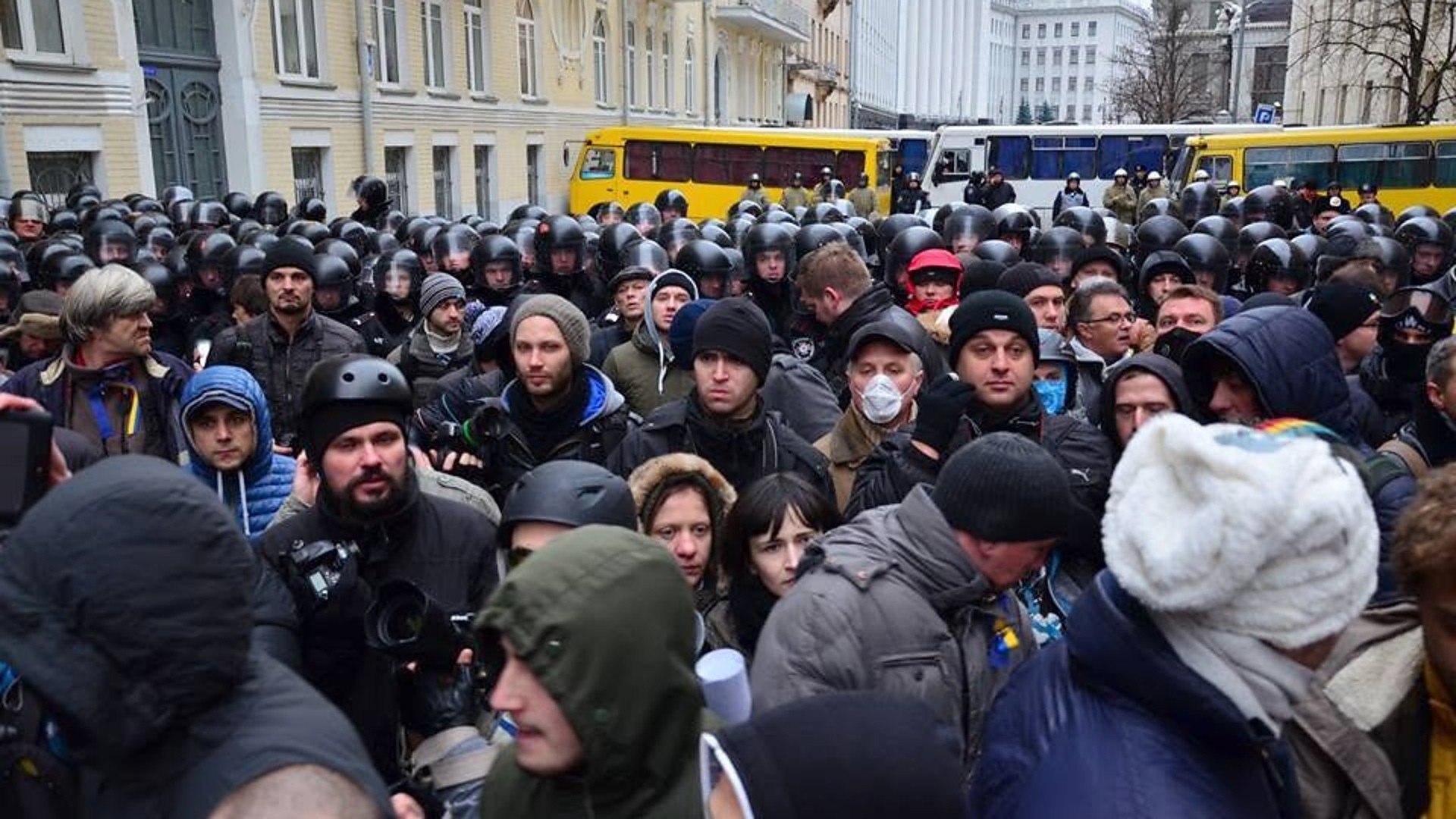
Olia Salo and I, together with other random passers-by, first tried to separate these two groups. I put myself in the way of the paving stones so they wouldn’t hit the law enforcers. Although it was already snowing outside, I was hot, my cheeks were burning. After a while Olia pulled me out of the epicenter and led me away. One of the Internal Troops soldiers whispered to her that we should leave immediately, because something was about to start. And that was true — the clearing began. Most of the young men in balaclavas ran away, while random passers-by who had come to look or had protected the soldiers were beaten or even maimed. I still believe that this tractor and the senseless attack were sabotage against the revolution.
Then there was also the storming of the Maidan on December 11 (under the influence of emotions I wrote a report then) and the days of the shooting of the Heavenly Hundred, which I spent in Lviv, because I had gone home for two days to say goodbye to my family, just in case.
What conclusions did you draw for yourself and/or how did the Revolution of Dignity affect you?
The people have the right to rebel. And they can use it if legal instruments don’t work. My thoughts that revolution is a matter for the next generation are amusing. Joining fateful processes is, in Franko’s words, the dog’s duty of every citizen, regardless of age or experience. Among my acquaintances there are people who have taken part in resistance since the time of the Sixtiers. Every time they assure me: never again, and then they join in once more. That, probably, is my fate too. And also — however much we argue in calm times, when the need arises, we will meet at the barricades. On the same side.
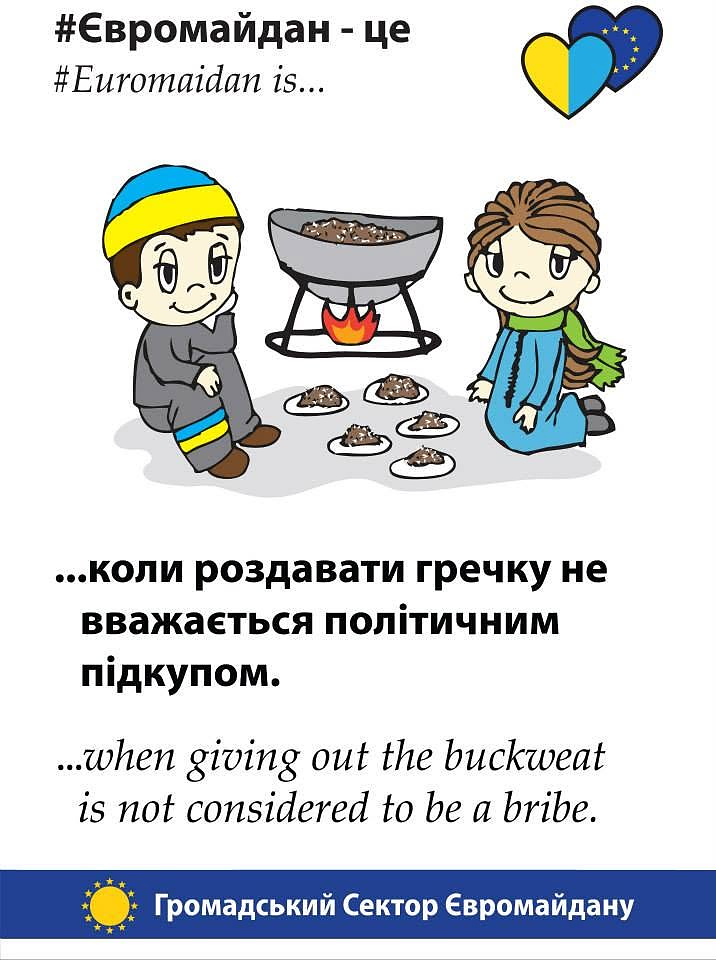
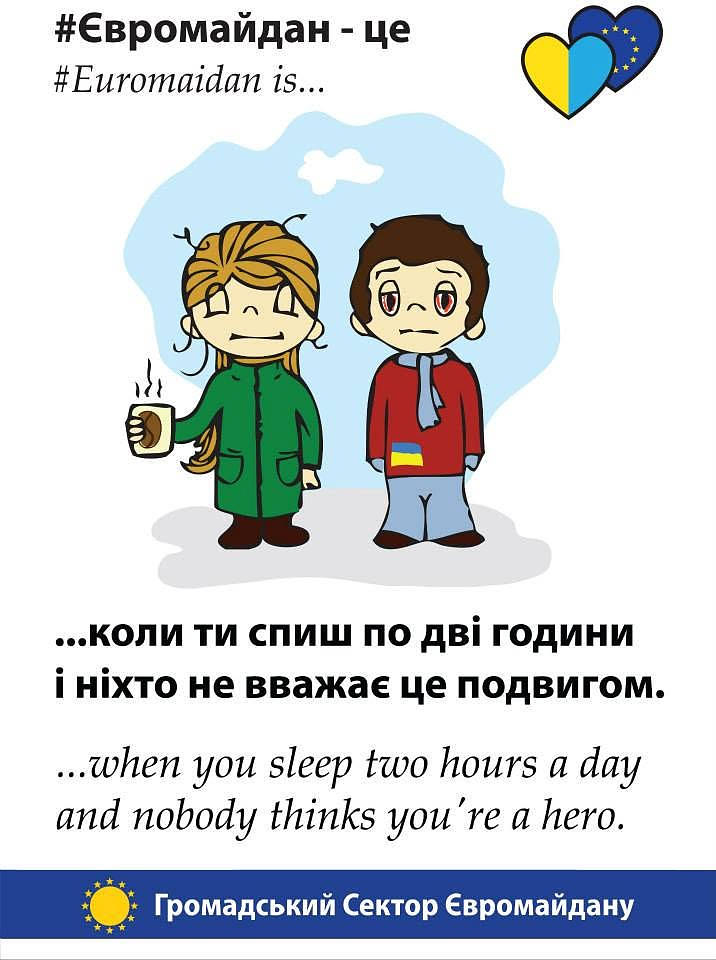
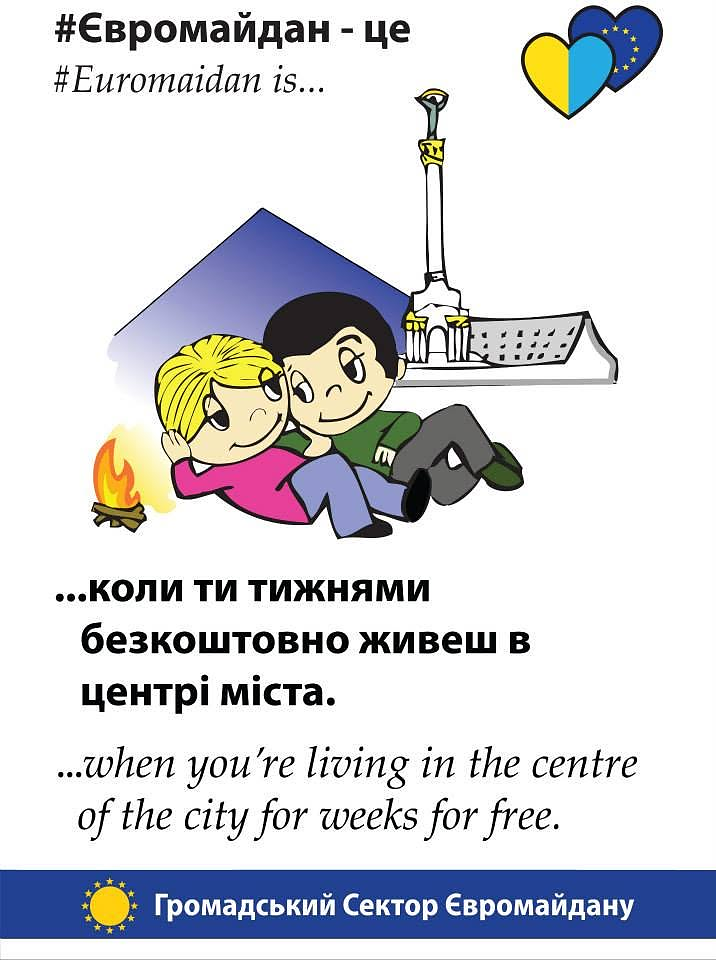
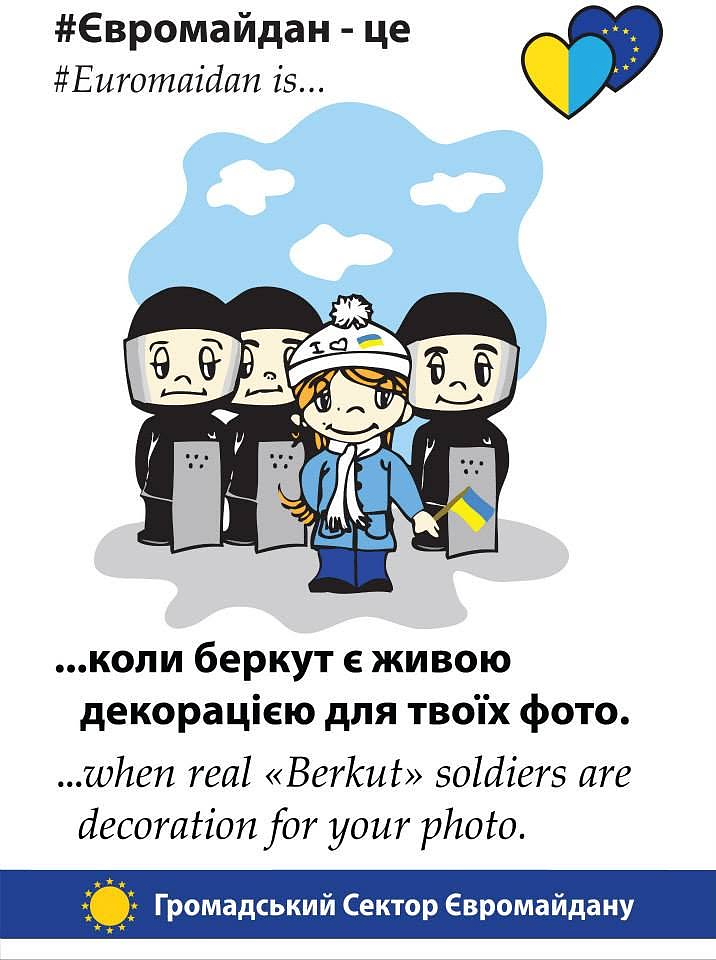
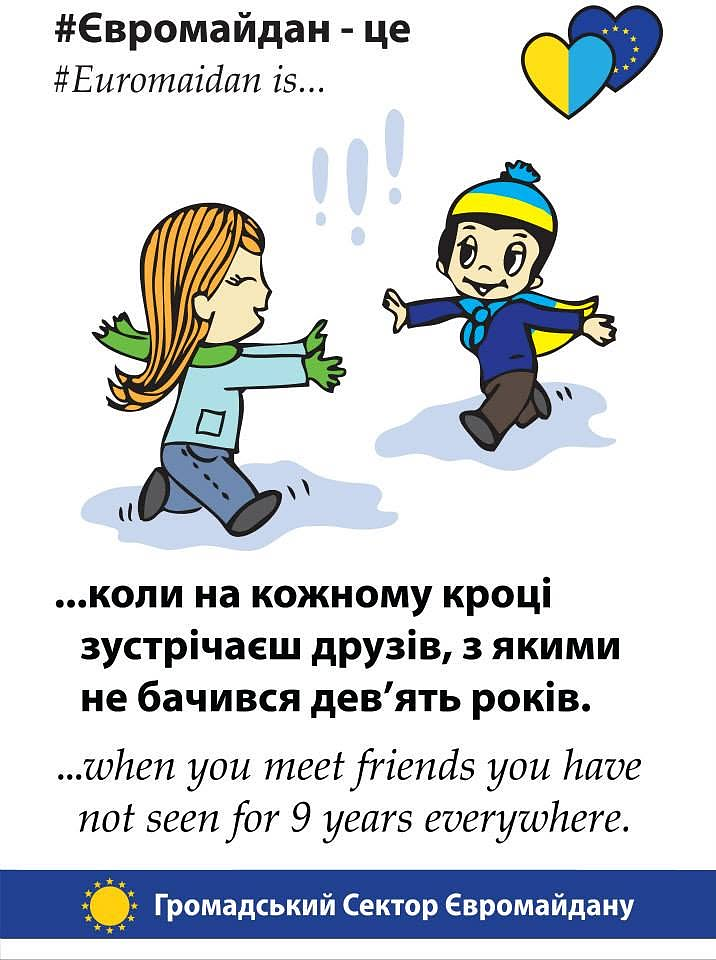
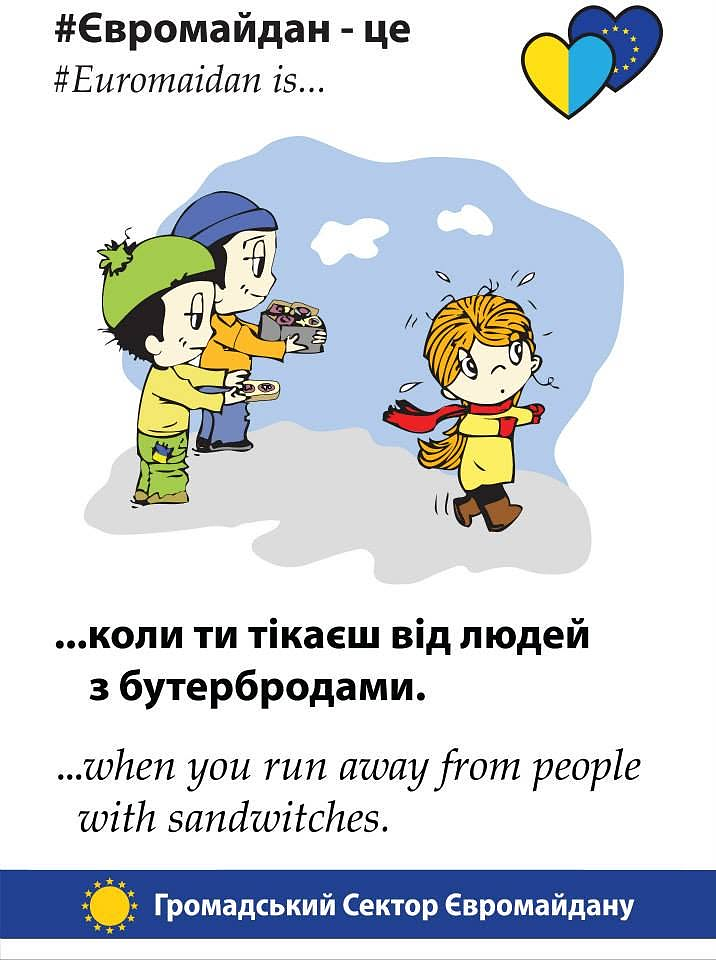
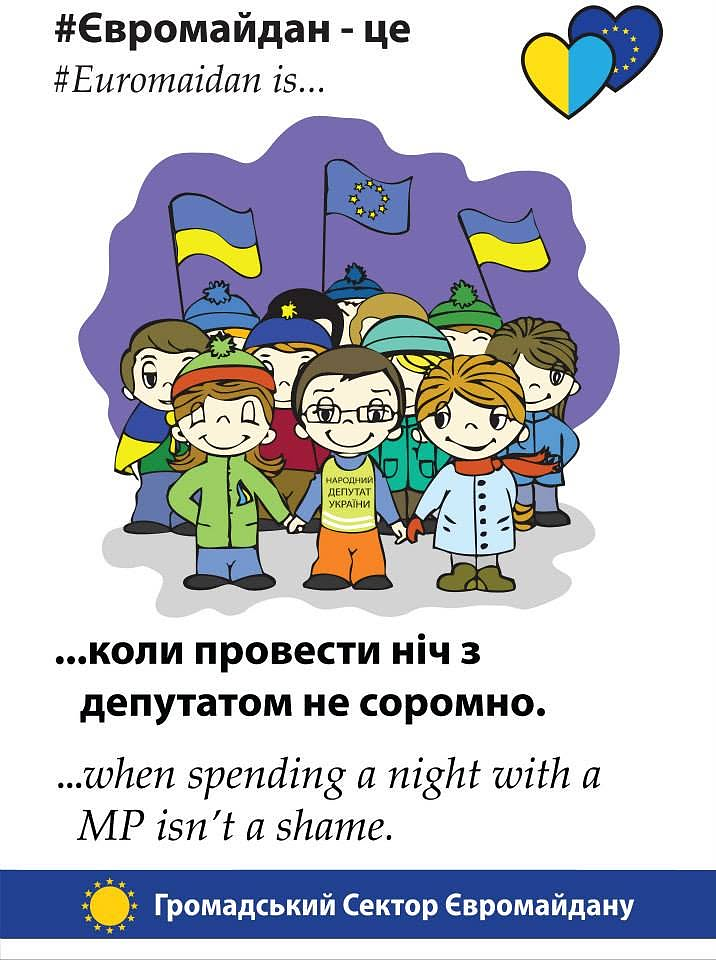
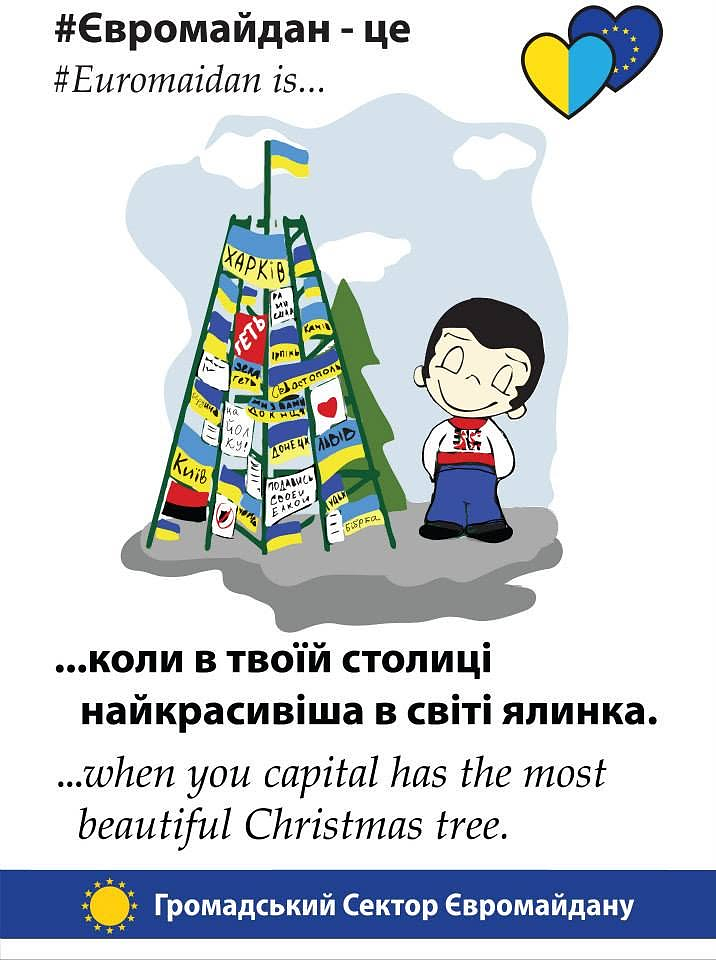
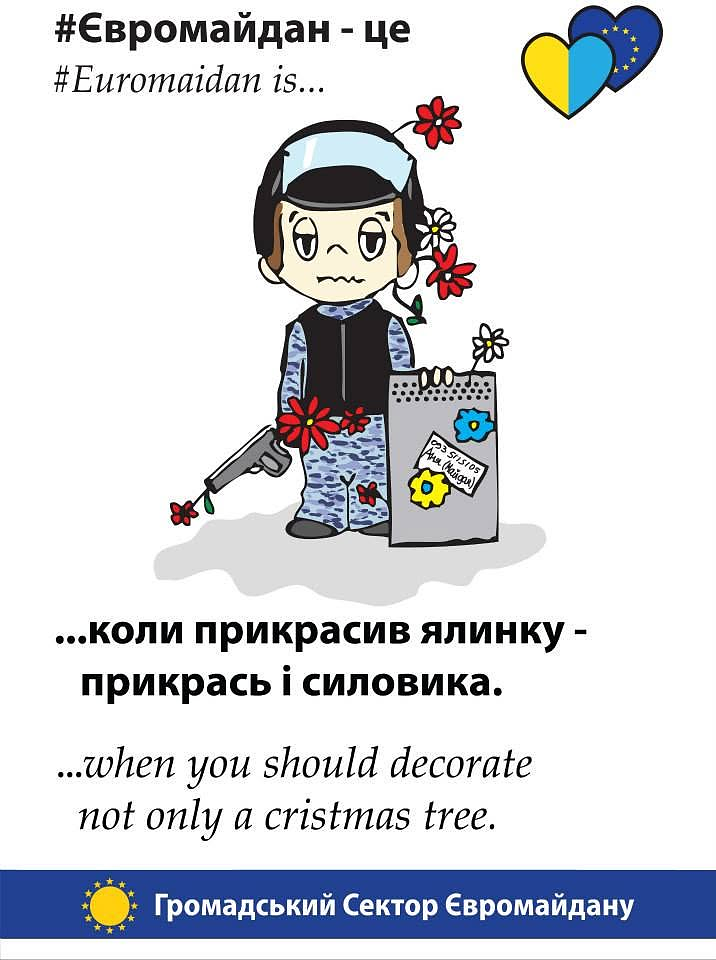
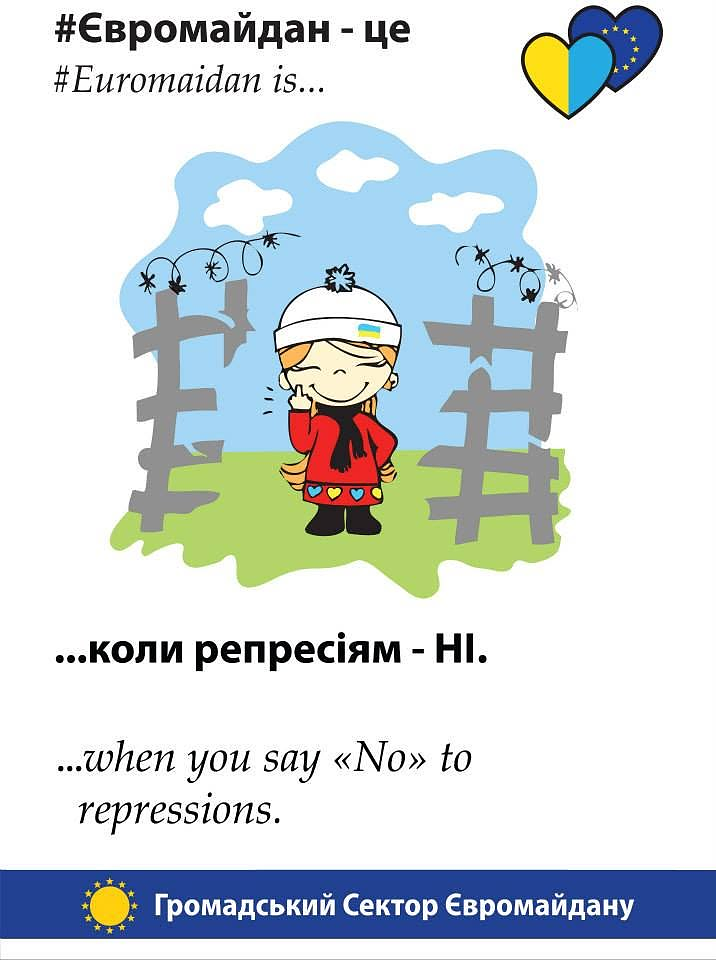
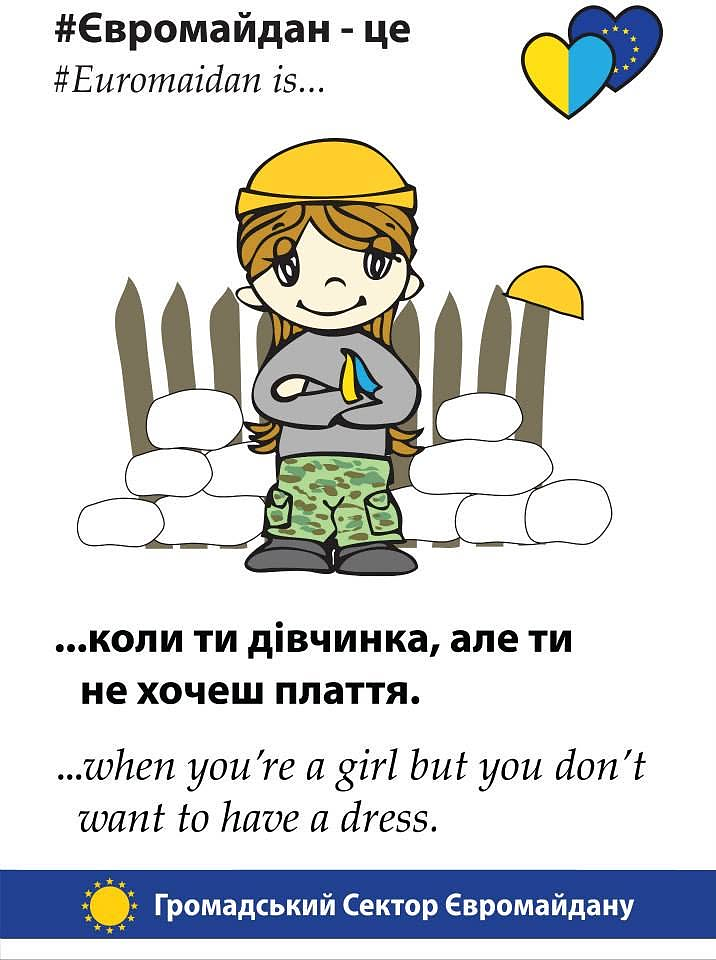
The candy wrappers were born of the need to show the real Euromaidan with its diversity and wit. Vasylyna Duman came up with the ideas for most of them. They were drawn by artist Sasha Navrotska.
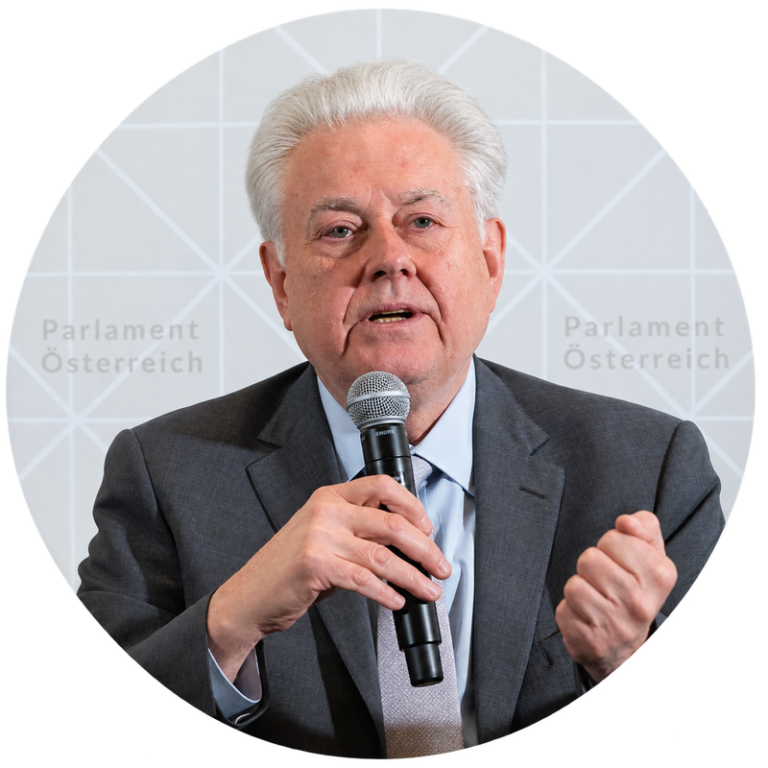
Volodymyr Yelchenko
Head of International Policy Research.
Permanent Representative of Ukraine to the UN in 1997–2001. Permanent Representative of Ukraine to the UN Security Council in 2000–2001 and 2016–2018. Ambassador of Ukraine to the United States, Russia and Austria.
During the Revolution of Dignity, he served as Ambassador of Ukraine to the Russian Federation.
Where were you when the Revolution of Dignity began? Did you expect the protests to grow to such a scale?
At that time I was serving as Ambassador of Ukraine to the Russian Federation, so the Revolution of Dignity found me in Moscow. Up until November 21, while the documents for association with the European Union were being prepared, Russian pressure on Ukraine to dissuade us from signing the Agreement grew with each passing day. We followed this closely and reported to Kyiv. However, until the very last day nobody believed that the authorities would really back out.
All embassies, including ours in Moscow, not only supported this process but also received instructions from the Ministry of Foreign Affairs of Ukraine to facilitate it in every way, which, incidentally, I did. And when, finally, literally a few hours before the start of the Vilnius Summit on November 28–29, it became completely clear to us that Yanukovych would not sign the agreement, it was a real shock. At least for Ukraine’s diplomatic corps.
Well, and then what happened, happened. Yanukovych eventually backed down. It all ended with his visit to Moscow, where on December 17 the notorious agreements were concluded on granting Ukraine a loan of 15 billion dollars (of the promised amount, only 3 billion was transferred — Ed.) It looked like a bribe to the Ukrainian authorities of the time for agreeing not to move closer to the European Union.
In those days, at some reception, I met Russian Foreign Minister Sergey Lavrov. He assured me very smugly then: “Oh, now everything will be fine. Ukraine is much better off this way. At last we will start building a real union between Ukraine and Russia.”
At first the Russians did not perceive the Maidan as a threat to themselves. A few days before the violent dispersal of the demonstrators, on November 28, several delegations from Kyiv came to Russia. The Ukrainian side was headed by Volodymyr Rybak, who was then Chairman of the Verkhovna Rada of Ukraine. The delegation members had talks with their Russian counterparts. And the Russians, all as one, said: “You have to disperse the rallies, show strength.” I heard this personally. The Ukrainian side, understanding the national specifics, was not unanimous in choosing a forceful scenario. The Russians, meanwhile, mirrored what they would do at home: disperse, shoot everyone, and in Moscow that would have been the end of it. In Ukraine, though, everything happened the other way around — the protests erupted with new force. And I had a premonition that this is exactly how it could end.
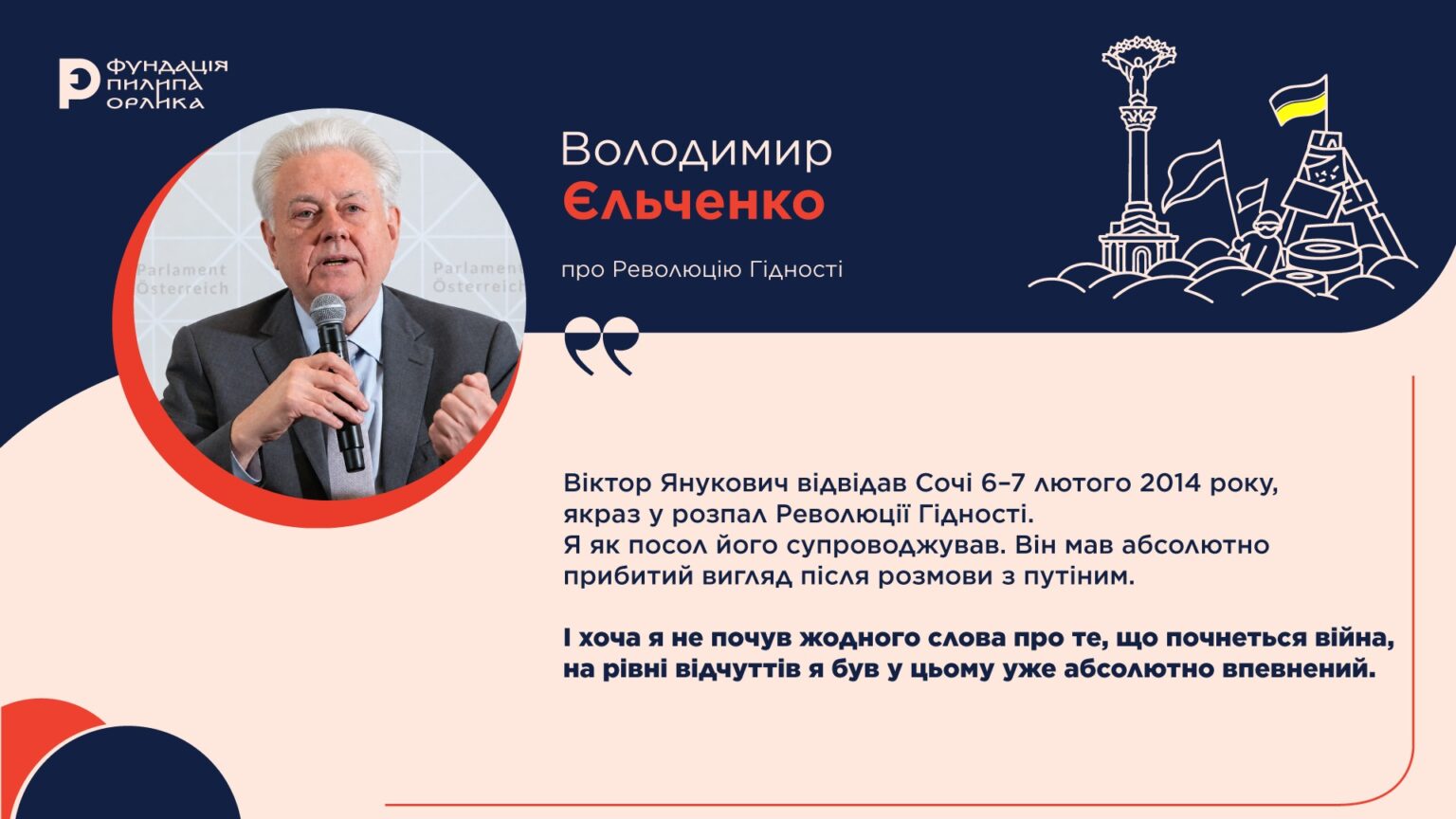
Viktor Yanukovych visited Sochi on February 6–7, 2014, right at the height of the Revolution of Dignity. As ambassador, I accompanied him. He looked utterly crushed after his conversation with putin. And although I did not hear a single word about a war beginning, on the level of feelings I was already absolutely certain of it.
You know how events unfolded after that. I was recalled on March 17, 2014. Later the so-called State Duma of the Russian Federation voted for the decision to annex Crimea to Russia, which was in fact an occupation. I hope I was the last ambassador of Ukraine to the Russian Federation. At least in its current configuration.
What from that time is most deeply etched in your memory?
In Kyiv, despite the revolution, there was a Ukrainian-Russian meeting that discussed the presence of the Russian Black Sea Fleet in Ukraine. As ambassador, I was part of the working group on the Ukrainian side. I came to Kyiv for February 18–20. I stayed in a building on Hrushevskoho Street, near Mariinskyi Park.
Early in the evening of the 18th, after one of the sessions, I returned to the apartment. I went out onto the balcony and saw some people starting to run through Mariinskyi Park, and in different directions. Only later did I realize that these were the so-called titushky.
They ran through the park and through the courtyard of our building. I heard some shots and couldn’t understand what was going on. It all became clear later. In the morning there had been an action, the “Peaceful Offensive”. Clashes were still going on then. And in the evening a large group of titushky moved towards European Square.
I remember standing on the balcony then with the feeling that some action movie was being filmed. I just couldn’t accept that this was really happening. But it was reality, unfortunately.
By the way, near our building there is still a memorial spot where candles are constantly burning and people lay flowers. One of the protest participants was killed here. Practically under my windows.
What conclusions did you draw for yourself and/or how did the Revolution of Dignity affect you?
I will answer very briefly. At that moment I understood that from then on the real independence of Ukraine as a state was beginning. Everything that came before was only attempts to become independent.
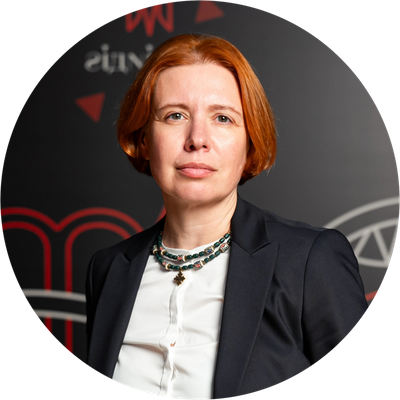
Yaryna Yasynevych
Program Director of the Pylyp Orlyk Foundation.
During the Revolution of Dignity, she was a co-founder of the Euromaidan Civic Sector — a hub aimed at supporting the protest and preserving its non-violent character.
Where were you when the Revolution of Dignity began? Did you expect the protests to grow to such a scale?
For me, the Euromaidan began on the very first evening, November 21, 2013. We had just finished the premiere of an opera dedicated to the memory of the victims of the Holodomor, and together with many of its participants we went to the Maidan. We spent the evening there and then went our separate ways to prepare events for the anniversary of the Holodomor.
Just a few days later, on Saturday, more than ten thousand people gathered to honor the memory of those killed by famine. Most of them went to the Maidan after the commemoration ended. And we had the honor of leading that column.
After that I went to Rome on business. The student protest was going on at the time, and it was gradually starting to run out of steam. I returned to Kyiv at night, picked up my husband from the Maidan, and we went home to sleep. And literally a few hours later we learned about the brutal beating of the students.
We immediately returned to St. Michael’s Cathedral, where a coordination headquarters was already forming. So from the very beginning we plunged into the revolution. In particular, we took on organizing the huge, million-strong people’s veche on December 1.
That day His Beatitude Lubomyr Husar, former head of the Ukrainian Greek Catholic Church, came out to the Maidan together with representatives of the “First of December” Initiative Group, with which I worked as a communications specialist and volunteer. His words “Do not be afraid!” rang out over the whole Maidan.
What from that time is most deeply etched in your memory?
First of all, it was a sea of people and the feeling of the Maidan as a fortress. Paradoxically, at the epicenter of the protest, behind the barricades, among people who had risen to defend Ukrainian freedom, I felt safe. And everything outside the Maidan seemed much more dangerous, and often hostile.
Especially when the authorities began to resort to provocations, to use titushky and criminals disguised as Maidan protesters, when abductions of activists and violence began.
The second extremely strong feeling was unity with the whole country. When protests and uprisings began to flare up in cities all over Ukraine, came the understanding of how many Ukrainians actually supported this movement — towards Europe, towards freedom and away from Russia.
There was a feeling that the Maidan had gone far beyond the Kyiv square.
Among the funny episodes, I of course remember watching the Lenins fall. We would call friends in other cities and ask: “Why is your Lenin still standing?” This too was a kind of symbol of how the country was changing literally before our eyes.
But there were also very hard moments that I don’t want to recall in detail now. The deaths of close friends. And the feeling of anxious readiness in the face of the threat that was looming.
The country began to split, including the security forces. Some law enforcement officers took the side of the revolution and came to Kyiv. And it was no longer clear which people in uniform posed a mortal danger to you and who had taken the side of law and the people.
The threat of civil confrontation, even civil war, which Russia could instigate and exploit, was felt very acutely. But that did not happen. The people won, the president fled. And Russia moved to direct, open aggression against Ukraine.
What conclusions did you draw for yourself and/or how did the Revolution of Dignity affect you?
The main lesson is that you have to be prepared.
Preparedness makes it possible to conserve strength, protect people and move towards the goal. In 2004 we were more prepared than in 2013. And in 2014 it turned out each time that we were ready for the previous challenge, while a new one was already in front of us. And, in fact, from 2013 until now the stakes on this path of struggle for freedom keep rising every time.
We are still coping. Even now I think that I am coping. But I ask God for strength and wisdom to keep coping.
Svitlana Kvitnytska
Member of the Board of the Pylyp Orlyk Foundation.
She has more than 10 years of experience in the strategic management of social, medical and humanitarian programs. At the Foundation, she coordinates projects of varying complexity.
At the Revolution of Dignity, she realized she wanted to work in charity.
Where were you when the Revolution of Dignity began? Did you expect the protests to grow to such a scale?
For me, the starting point was the episode with the beating of the students. Before that we just followed the news. And on November 30 I came home from work and saw the news about the violent dispersal. My husband and I immediately got into the car and drove to the Maidan.
We lived outside the city, so mostly we helped with the car. We drove food to the checkpoints between villages and delivered medicines to the headquarters. On the Left Bank, in the Patriarchal Cathedral of the Resurrection of Christ, there was a point that received people coming to the Maidan. We brought bedding, towels, medicine, preserves there — everything that was needed.
What from that time is most deeply etched in your memory?
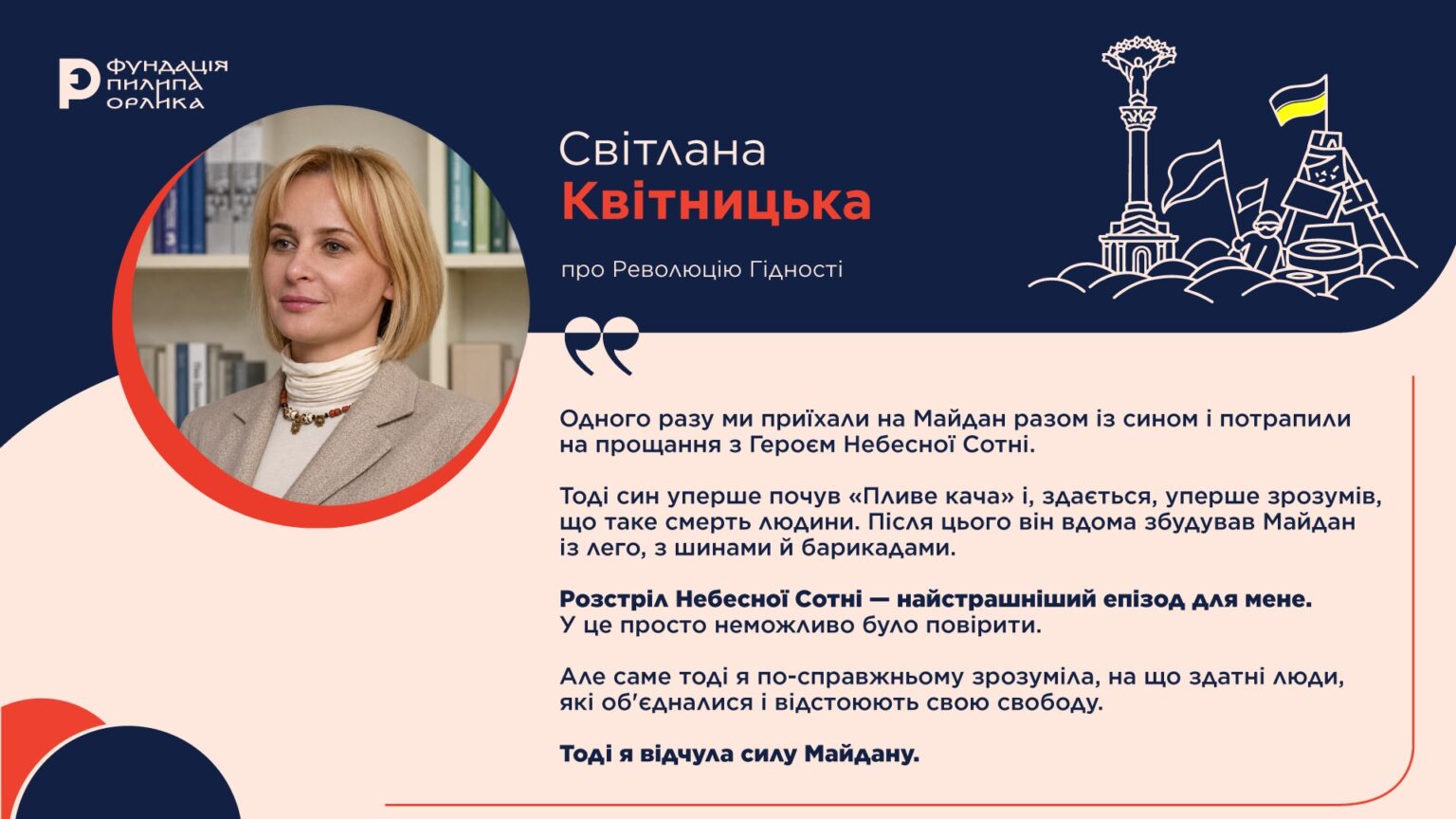
Once we came to the Maidan together with our son and found ourselves at the farewell to a Hero of the Heavenly Hundred. That was when our son first heard “Plyve kacha” and, it seems, understood for the first time what a person’s death is. After that he built a Maidan out of Lego at home, with tires and barricades.
The shooting of the Heavenly Hundred is the most terrible episode for me. It was simply impossible to believe. But it was then that I truly understood what people who have united and are defending their freedom are capable of. That was when I felt the strength of the Maidan.
And I still remember the smell of the Maidan. When the full-scale invasion began, my husband was on duty at checkpoints. His clothes, when he came home, smelled exactly the same.
What conclusions did you draw for yourself and/or how did the Revolution of Dignity affect you?
After the Maidan, I realized I wanted to work in charity. I worked for many years at a charitable foundation, and for the last few years I headed it. Then the Pylyp Orlyk Foundation came into my life.
In general, our whole family changed radically. Our son, as I mentioned earlier, realized the value and fragility of life. My husband decided for himself that law enforcement must change and joined the police after the reform. Our son saw him in uniform for the first time and asked: “You won’t have to shoot ordinary people now, will you?” Then the two of them had a long conversation about how dad had put on the uniform specifically so that the police would never again kill innocent people.
Olha Salo
Head of Cultural Initiatives at the Pylyp Orlyk Foundation.
For more than 15 years she has worked in the fields of cultural heritage, museum work, cultural policy and national memory policy. Since 2022 she has been involved in crisis response to threats to cultural heritage in wartime. In 2016–2026 she worked at the National Museum of the Revolution of Dignity as Deputy Director General for Development and Cultural and Educational Work.
During the Revolution of Dignity, she was an activist of the Euromaidan Civic Sector. She was responsible for working with volunteers, organizing trainings in non-violent resistance, and communicating with Euromaidans in the regions.
Where were you when the Revolution of Dignity began? Did you expect the protests to grow to such a scale?
For two months before the announced date of signing the Association Agreement with the EU, my friends and I had been preparing a large-scale all-Ukrainian flash mob in support of European integration. About a hundred universities across Ukraine were to take part. To this end, we held meetings with young people in all regional centers and smaller towns, including in Crimea.
Azarov’s statement on abandoning European integration meant for us that this action now had to be held — not just desirably, but necessarily. But students from a number of eastern and central regions “crumbled” — they started cancelling flash mobs, fearing persecution by university administrations and local authorities. This transformation happened in a single day; it shocked us and, frankly, did not add optimism about the possibility of a large-scale protest.
Also, in those days Ukraine was to mark the 80th anniversary of the Holodomor. The authorities of the Yanukovych era denied the genocide and withdrew from organizing commemorative events. Everything fell on the shoulders of the public. I was on the organizing committee for the commemoration. It was on November 21 that an opera about the Holodomor was presented. So my friends and I set off to the Maidan in the evening straight from the opera house. I also remember that at the Ukrainian House they were preparing the opening of an exhibition dedicated to the Holodomor that night, so we divided that first night of the protest between this exhibition center and Maidan Nezalezhnosti.
What from that time is most deeply etched in your memory?
I will single out three episodes: the storming of the Maidan on the night of December 11, 2013, the abduction of Yurii Verbytskyi and Ihor Lutsenko, and the death of Bohdan Solchanyk.
The protesters managed to repel the storming of the Maidan on December 11. The bells of St. Michael’s Golden-Domed Monastery that night still move me whenever I remember them. That was the time the cathedral rang the alarm. The bells rang for several hours. It seems to me that that night everyone who was on the Maidan, and everyone who was with the Maidan, experienced a catharsis: we held out, and, I think, it was then that we most clearly saw one of our own in each other. Strangers became family, felt responsibility for one another and readiness to keep standing, whatever lay ahead.
From the abduction of Verbytskyi and Lutsenko I remember a feeling of horror and helplessness. Lutsenko was on our Euromaidan Civic Sector team. While we remained in the dark, time was lived as if you were in hell. Verbytskyi was tortured to death then. Fortunately, Ihor Lutsenko got in touch. He had also been brutally tortured, but he survived.
I met Bohdan Solchanyk on the Maidan on the night of February 20. We had been friends since the Orange Revolution. He had just arrived from Lviv and asked me to find him protective gear. Everyone understood that the Maidan would be cleared. So Bodia was preparing to join the defense. We no longer had any homemade shields, or metal helmets, let alone homemade body armor. The only thing I could find then was some impact-resistant knee pads. And on the morning of February 20 his friend called me with the words “Bodia has disappeared. He’s not answering his phone.” I went to check the field hospitals — there were several such locations on the Maidan. On the way I stopped by the dead laid out on the street, who were being carried down from Instytutska. And it was a feeling of catastrophe. The brain refused to perceive it as possible or real. Eventually Bohdan was found. His body was brought and laid next to several other dead near the Kozatskyi hotel. The blood of the killed was still flowing from their wounds, mixing with dirty melting snow. Some man kept trying to gather it with his scarf: very carefully, almost reverently. So that people wouldn’t accidentally step on it…
What conclusions did you draw for yourself and/or how did the Revolution of Dignity affect you?
I’m not sure my worldview changed. But my admiration for the people around me has certainly not faded to this day: everyone is very different, with such a diversity of views, they can be uncomfortable, harsh or something else — but in every man and every woman there is the potential of that “drop in the ocean” that can change the country. And since the Revolution of Dignity we have seen the power of those “drops” more than once.

Oleh Zaiarnyi
Academic Advisor of the Pylyp Orlyk Foundation.
Doctor of Law, Professor at the Department of Intellectual Property and Information Law of the Educational and Scientific Institute of Law of Taras Shevchenko National University of Kyiv. At the beginning of the Revolution of Dignity, he combined research and teaching with the duties of an assistant-consultant to a People’s Deputy of Ukraine.
Where were you when the Revolution of Dignity began? Did you expect the protests to grow to such a scale?
It’s hard to say now exactly what I was doing on November 21, when the Azarov government shelved the association with the EU. I remember that on that day I was at the UDAR party office and at the university. At that time I specialized in drafting bills and other regulatory documents. The details have been forgotten, but the feeling has remained. I understood that this was a critical turning point: either Ukraine would hold out and go for democratic transformations, or it would fall under the pressure of law enforcement agencies and that would be the end.
I was convinced that the call to go to the Maidan mattered more than it seemed at first glance. And that we were entering a historical period when the question would be put point-blank: either-or, the European Union or Russia. Even Yanukovych’s fellow party members tried to persuade him not to shelve the association with the EU completely, but to look for some compromise solution, because they too understood that this would provoke confrontation in society. In the last week before the street protests, the situation was reaching boiling point.
While the young people were gathering on the Maidan, my colleagues and I were preparing a legal foundation for them, so that law enforcement would not find the slightest legal grounds to ban the protests. The actions continued until November 29, and early on the morning of the 30th I was woken by a phone call from an MP — everyone gather immediately, there’s a brutal violent dispersal on the Maidan, many demonstrators have been detained or maimed.
Within an hour we had already set up a humanitarian headquarters, where people had been bringing blankets, clothes, food, money and medicines since the night. Those of the MPs, assistants or lawyers who were on site with ID cards and could immediately take on legal support went to what were then still militsiya stations and to hospitals, so that not a single violation could be concealed.
Lawyers, together with the victims, applied to the Register of Criminal Proceedings — checking whether the materials had been entered. They wrote attorney’s requests to the Ministry of Internal Affairs: who went out on the operation, which investigative teams were involved, who gave the orders. They made copies of documents, promptly passed them to journalists, and so on. In short, the legal machine started working right away.
At the same time I had to teach classes at the university. And it was like a game of make-believe. Because the students pretended they weren’t sleepy, and I pretended I couldn’t smell the Maidan smoke on them. Although everyone understood everything.
What from that time is most deeply etched in your memory?
What impressed me most was the synergy effect. When, joining forces, we did previously unthinkable things. In a short time we managed to deploy a network of legal aid with on-site visits. We organized shifts on the Maidan, because when MPs or assistants with ID cards were with the demonstrators, the security forces thought twice about whether to start an attack. This was especially important at night. At the same time we held official receptions as deputy’s assistants wherever there was a need. We promptly processed urgent appeals at the Trade Unions Building. We provided legal support for importing aid from abroad. We joined actions. On top of all that, we still managed to get back to the office and quickly work through legislative initiatives. Do you remember the law that strengthened criminal liability for attacks on the lives of journalists and their family members (Law of Ukraine No. 421-VIII, registered on January 24. — Ed.)? My colleagues and I developed it together.
What conclusions did you draw for yourself and/or how did the Revolution of Dignity affect you?
My wife and I switched completely to Ukrainian. First between ourselves, and then we stopped switching to Russian even when talking with relatives, friends and colleagues. I decided to ignore letters or invitations if they were in Russian.
I also not only understood, but realized at the level of an insight, that Ukraine had come out from under Russia’s influence. I remember that back then we started preparing documents on denouncing some of the CIS conventions and various treaties and protocols. And already at that moment I saw clearly: whatever happened, Ukraine would never return to that orbit.
From professional observations. I noticed how civic institutions grew and gained weight. In many respects they became more effective than state ones. It is the public, through peaceful assemblies, expertise and civic initiatives, that can do more.