
The piece by journalist Luke McGee, who covers European diplomacy, discusses the initiative of Ukrainian experts to review the legitimacy of Russia’s membership in the UN. Among its participants is Volodymyr Yelchenko, former Permanent Representative of Ukraine to the UN and now Head of International Policy Research at the Pylyp Orlyk Foundation.
Below are several excerpts from the Foreign Policy article that set out the legal arguments of the Ukrainian side and the possible mechanisms for raising the question of Russia’s status in the UN.
The full text of the article in the original language is available here: https://drive.google.com/file/d/1gs0nTcUH940tX78H2zr8A6Jr24krnF5p/view?usp=sharing
Owing to the peculiarities of the United Nations’ early policy, the Union of Soviet Socialist Republics (USSR) held three seats in the organization — for the USSR, the Byelorussian SSR and the Ukrainian SSR. The USSR itself was formally a federation of many Soviet republics, including the Russian Soviet Federative Socialist Republic.
When the Soviet Union collapsed, its constituent parts became independent states. Therefore, Ukrainian experts argue, the Russian Federation was a new state, not simply a renamed USSR. States that change their name can be recognized by the UN simply by sending a notification, but the process of recognizing a new state is longer and more complicated.
Volodymyr Yelchenko, former Permanent Representative of Ukraine to the UN and Head of International Policy Research at the Pylyp Orlyk Foundation, believes that recognizing the newly formed Russia as the successor to the USSR was a mistake.
“It is the biggest fraud of the century; the Russian Federation never signed the UN Charter,” Volodymyr Yelchenko said.
Other states that emerged from the breakup of larger state entities went through a more complicated procedure of formally joining the UN. Russia, however, simply sent an informal letter instead of going through a formal admission vote under Article 4 of the UN Charter.
“Bosnia and Herzegovina went through this procedure under Article 4 in 1992, after the breakup of Yugoslavia. But the Russians did nothing of the kind — they simply replaced the nameplate on the desk,” Yelchenko noted.
Ukrainian experts expect that a public discussion will prompt UN member states to answer a fundamental question: if Russia applied for membership today, would it meet the criteria of Article 4 of the UN Charter, in particular the requirements of being a peace-loving state that accepts the obligations of the Charter and is able and willing to carry them out?
One of the proposed mechanisms is to refer the question of the Russian representatives’ credentials to the UN Credentials Committee. At the same time, the General Assembly may consider a relevant proposal and hold a vote. Unlike substantive resolutions, procedural decisions of the General Assembly are not subject to the Security Council veto.
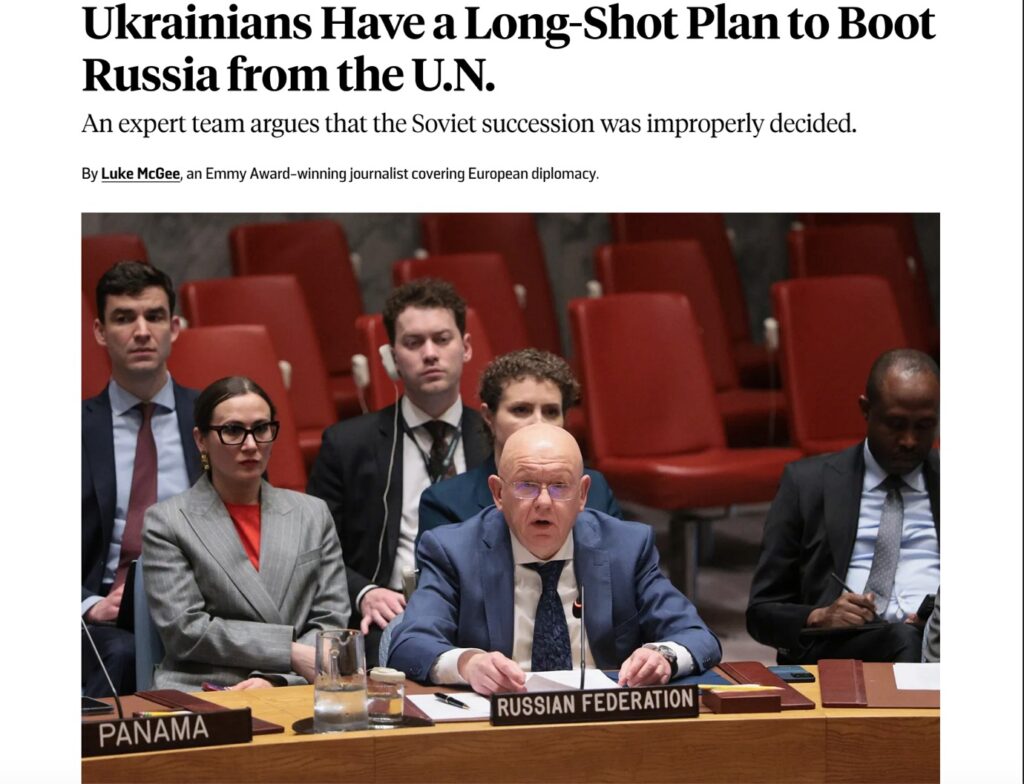
Asked why so much effort should go into stripping Russia of its legitimacy at the UN when Russian missiles strike Ukrainian cities every day, Volodymyr Yelchenko replied:
“Russia uses the UN for many purposes, including wielding its veto to protect itself and other aggressors. But it also uses the UN as a megaphone for spreading propaganda.”
That is why, according to Ukrainian experts, the question of Russia’s UN membership goes beyond a formal legal procedure. It is also about the possibility of depriving Russia of one of its instruments of international political influence.
The practical likelihood that the United Nations will suspend Russia’s membership over formal defects, let alone strip it of its seat on the Security Council, is extremely low. Still, the Ukrainian team sees benefits even in forcing this discussion to take place.
At the same time, the author of the article also points to the skepticism of part of the diplomatic community. Among the reservations is the risk of losing allies’ political support if the initiative fails publicly.
Ukraine has managed to secure broad support for past UN resolutions condemning the Russian invasion, but it may find it harder to find allies willing to push for the suspension of Russia’s membership.
“It may sound crazy, but if you look at the facts and the rules, Russia is not a member of the UN,” Volodymyr Yelchenko said.


