
Key findings of the study:
Russia systematically influences the Czech information space through a network of proxy resources. We examined more than 165,000 publications from 21 Czech sites that spread propagandistic, destructive, or conspiratorial content, analyzed over 22,000 YouTube videos, and reviewed more than 1.8 million comments.
66% of the publications on these online media outlets contained at least one propagandistic narrative. In total, 55 such narratives were identified across seven thematic groups: the war in Ukraine, Russia, the US, Europe, the Czech Republic, Ukraine, and international events. The combined monthly traffic of these sites is 10.18 million.
The most persistent narratives concern Russia’s inevitable victory and the ineffectiveness of aid to Ukraine (“Ukraine is losing the war” — 28,095 publications), Trump the peacemaker who uses Ukraine and peace talk for his own benefit (“Trump’s peacemaking strategy” — 17,344), and the EU and Britain dragging out and provoking a war against Russia (“The EU and Britain are prolonging the war in Ukraine” — 12,404).
The low-quality Czech outlets analyzed take information directly from Russian sources, including RT, TASS, RIA, and the social media accounts of well-known propagandists. This is the main channel through which propaganda enters the Czech information space, pointing to the structural integration of Czech “alternative media” into a broader Russian information infrastructure.
An important tool for promoting Russian narratives is the comments under related YouTube videos. The study identified more than 2,700 users who write comments in both the Czech and Ukrainian segments of YouTube simultaneously. Of these, at least 570 behave like bots or internet trolls. Notably, repeated commenting with identical phrases was recorded.
Disinformation works like poison. Its effect is often invisible at first, but if an antidote is not found in time, the consequences can become irreversible. This poison spreads fastest through existing cracks in society: internal conflicts, political polarization, discontent with the government or EU leadership, economic anxiety, or cultural irritation linked to liberal change.
This toxin is spread by pro-Russian political forces, information platforms directly or indirectly linked to Russia, and networks of sympathizers and situational allies — from online media to social platforms.
In this study, we focused on two key channels for the spread of such influence: low-quality Czech online media and YouTube, where information warfare is often disguised as ordinary public discussion.
We compiled a sample of 21 Czech-language conspiratorial and disinformation online media outlets. According to SimilarWeb, the combined traffic of these sites in April was more than 10 million. (It is important to understand that 10 million visits does not mean 10 million readers: one person can visit a site dozens of times, and each such visit is counted separately.)
We selected 26 Czech YouTube channels covering a broad spectrum of Czech public discourse: public media, independent online media, influential figures and podcasters, far-right and conspiratorial channels, as well as YouTube channels of political parties and public figures. In total, we analyzed 22,283 videos and more than 1.8 million comments.
Study period: February 2025 – February 2026.
RESEARCH METHODOLOGY
Websites
Publications were collected via a search using 50 Czech-language keywords. These covered topics such as the war in Ukraine, rhetoric about the EU, migration, and other markers of FIMI discourse (Foreign Information Manipulation and Interference).
Each site had at least 100 publications on these topics. In total, we collected 167,941 publications.
The texts of the publications were broken into paragraphs and grouped by topic (clustered) using the BERTopic topic-modeling model with multilingual sentence transformers. After clustering, the texts were translated into Ukrainian using DeepL. Each cluster was manually assigned a category (broad topic) and a narrative (specific message).
Topics unrelated to Ukraine and politics were excluded from the analysis. In total, 55 narratives were identified across seven thematic groups: the war in Ukraine, Ukraine, Russia, the US, Europe, the Czech Republic, and international events.
We also collected all external hyperlinks from the sites’ articles and kept those referenced more than five times. Target domains were classified into categories: Ukrainian media, Russian media, Russian social networks, Czech media, Czech junk sites, and others. This made it possible to assess which sources the studied media rely on and how integrated they are into the Russian information ecosystem.
YouTube
Video titles and descriptions were also clustered using BERTopic. Clusters without a distinct thematic signal were excluded. In the end, 21 key topics were identified.
A BRIEF LOOK AT THE NARRATIVES
One of the main goals of the study was to track how disinformation narratives changed in the Czech information space. In this context, several important conclusions can be drawn.
First, pro-Russian propaganda is characterized by continuity and stability. It is not a series of random information attacks but a systemic and prolonged process of filling the information environment with the meanings the Kremlin needs.
Second, its strategy largely reproduces the same narratives that Russia promotes in its own information space and exports to other countries. In this sense, the Czech Republic is not an exception, but rather another front in a global information campaign.
Alongside global Russian messaging, there is also a separate layer of local adaptation. Some narratives are specifically tailored to the Czech context: history, internal political disputes, economic fears, and social anxieties.
Regarding the Russian storyline: on January 20, 2025, Donald Trump was inaugurated as the 47th president of the United States. For Russian propaganda, this was a long-awaited celebration, the culmination of a months-long media campaign in which Trump was portrayed as a messiah who would put an end to the West’s “anti-Russian course.” Similar sentiments prevailed on problematic Czech sites as well.
And when Trump failed to meet Russian expectations, could not fully pressure Ukraine, or openly criticized Russia, Russian propaganda would pivot, and the US president would be portrayed in a negative light — a shift that was repeated in Czech proxy networks as well.
For example, in July 2025 media reported that Russian state propaganda was ordered to criticize Trump after his criticism of Putin. We recorded criticism of Donald Trump as one of the top topics on the analyzed Czech sites as well. This once again demonstrates that these are not independent voices, but a network of relays that quickly shift tone in line with changes at the center.
If one conditionally classifies the narratives spread by destructive Czech sites, several main groups can be identified.
Russian meta-narratives — broad strategic messages about “the decline of the West,” “Russia’s inevitable victory,” and “the pointlessness of supporting Ukraine.”
Anti-European meta-narratives — discrediting the European Union and NATO, fueling euroscepticism, forming an image of Brussels as allegedly imposing its will on others.
Local Czech narratives work with internal societal fears: concerns about security, economic future, quality of education, healthcare, and the labor market. Topics of migration, Islamic radicalism, and terrorism are especially actively exploited here.
Anti-Ukrainian meta-narratives are a separate and extremely important category: claims of a “coup” in Ukraine during the 2014 Revolution of Dignity, calls to “force Ukraine into peace at any cost,” stories about “ungrateful Ukrainian refugees” allegedly worsening the lives of Europeans, or the image of Ukraine as a “black hole” in which European taxpayers’ money disappears without oversight.
The most dangerous aspect of this system is that such narratives do not always resemble external propaganda. They become embedded in public discourse, intertwine with real social problems (rising cost of living, anxiety over defense spending, uncertainty about the future), and gradually come to be perceived as “common sense.”
WHAT WAS WRITTEN ABOUT MOST OFTEN
The 10 most common narratives per month by paragraph count include: “Ukraine is losing the war,” Trump’s “peacemaking” strategy, “The EU and Britain are prolonging the war in Ukraine,” “Ukraine’s cruelty and crimes,” “Ukrainian refugees create problems,” “Minimizing Ukrainian successes” (category “War in Ukraine”); “Brussels as a threat to national sovereignty,” “Erosion of democracy and traditional values in Europe,” “Failures of EU energy policy,” “Europe is arming and preparing for war with Russia,” “Bad NATO and Western bloodthirstiness,” “We should act like Slovakia and Hungary,” “Anti-Russian sanctions,” “Migration is destroying European communities” (category “Europe”); “Trump is making America great again,” “Downgrading Ukraine’s priority in US policy,” “Trump’s tariff war,” “America against Venezuela,” “Shutting down the liberal and globalist ‘grant machine,'” “Trumpism against the ‘deep state,'” “Trump wants Greenland,” “Criticism of Trump,” “The killing of Charlie Kirk,” “The Epstein case” (category “US”); “Failures of pro-European Czech leaders,” “Victory of new forces in the Czech Republic,” “The healthy politics of the new Czech government” (category “Czech Republic”); “America against Iran,” “War in the Middle East,” “The rise of China” (category “International events”); “Ukraine as a failed state and a puppet of the West” (category “Ukraine”); “The greatness of Russia,” “Russia saved Europe from Nazism” (category “Russia”).
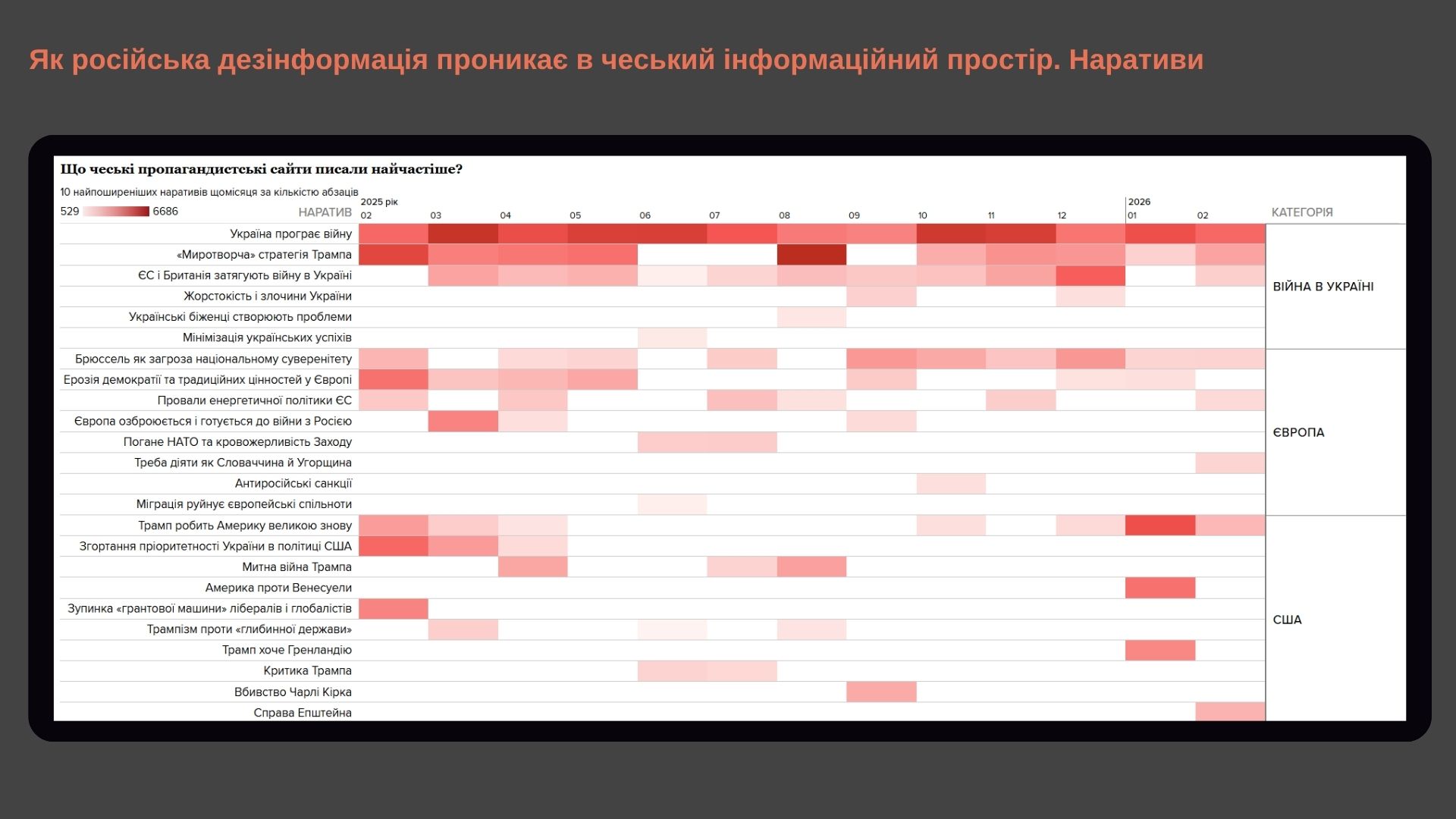
“UKRAINE IS LOSING THE WAR”
The most persistent and widespread pro-Russian narrative during the study period remained the line about Russia’s inevitable victory in the war (which we called “Ukraine is losing the war”).
In the military dimension, this narrative was built on the constant reproduction of the image of a Russian offensive. The materials systematically reported that the Russian army “is encircling Ukrainian forces,” “creating cauldrons,” “advancing on all fronts,” and “methodically eliminating Ukrainian units.” Any local fighting was presented as evidence of Moscow’s strategic advantage, and the offensive itself as a continuous and irreversible process. Ukraine may cease to exist as a state.
Another important element is the demonstration of Russian technological superiority. In this context, mentions of the “Oreshnik” hypersonic missile served not only a military but also a symbolic function: they were meant to prove that Russia retains strategic initiative and the ability to dictate the rules of the game while surprising and intimidating its opponent.
In parallel, an image of an internally weak Ukraine was constructed. Ukrainian military leadership was described as incompetent, and Volodymyr Zelensky as a leader detached from reality who does not understand what is happening within the Armed Forces of Ukraine and who is systematically lied to by his inner circle.
At the foreign-policy level, this narrative was supplemented by claims of Ukraine’s strategic dead end: that it will allegedly never become a NATO member and must accept territorial losses. If the war continues, Russia could go further: seize Odesa, cut Ukraine off from the Black Sea, and turn it into a “non-functional landlocked state.” Ukraine will not join NATO and must accept the loss of territory.
Claims about the futility of Western aid were sharply amplified. Europe, according to Russian sources, allegedly supplies Ukraine with “defective” weapons that do not change the balance of power but only prolong the suffering.
This meta-narrative is primarily aimed at Western audiences, including Czech society. Its main goal is not to convince people that Russia has already won, but to sow doubt about the wisdom of continuing to support Ukraine.
For Western audiences, the message is: Ukraine cannot change the course of the war, its resources are being depleted, its army is weakening, and Western aid is merely prolonging the inevitable. By this logic, any new arms supply or financial support appears not as an investment in security but as a waste of resources: aid to Ukraine depletes Czech resources, causes economic harm to ordinary citizens, and risks dragging the country into war.
Separately, the message works on the political fatigue of Western societies. The longer the war lasts, the easier it becomes to push the idea that “it’s time to negotiate,” even if the price of such negotiations is forcing Ukraine into territorial concessions. In this way, the Kremlin is trying to shift the focus of the discussion from “how to help Ukraine win” to “how to end the war faster.”
“THE EU AND BRITAIN ARE PROLONGING THE WAR IN UKRAINE”
Europeans’ private savings will be used to invest in the war, this narrative claims.
This is one of the key narratives that has gained strength amid declining US support for Kyiv. Whereas previously the Kremlin’s main enemy in its optics was Washington and NATO, the role of the war’s chief “beneficiary” is now increasingly assigned to Brussels and London. It is they, according to this logic, who prevent Ukraine from “stopping the bloodshed”: pushing it to continue the war, blocking negotiations, arming and financing it, and even preparing to send their own troops.
Russia positions itself as the side “ready for peace,” while the EU appears as an aggressive, militarized actor obsessed with the idea of Moscow’s strategic defeat. EU leaders’ diplomacy is hindering a swift end to the conflict, these materials claim.
In this storyline, Ursula von der Leyen allegedly “takes Europeans’ private savings for the war,” Macron dreams of “peacekeepers” who would contain Russia, and European summits in Paris and London are portrayed as clubs of conspirators continuing a proxy war at any cost.
This technique is a mirror reflection of guilt. The aggressor accuses others of its own actions. Russia, which invaded Ukraine, accuses Europe of “prolonging the war.” A state that systematically destroys Ukrainian cities talks about a “war party” in Brussels. This allows the Kremlin to simultaneously justify its own aggression and work to split the Western audience.
The real goal of spreading this narrative is not to convince everyone that Russia is right. It is enough to sow doubt: what if this really is someone else’s war? What if Europe has gone too far? If this idea takes root, support for Ukraine begins to be perceived not as the defense of international order and ordinary European life, but as an expensive indulgence of elites. And that is precisely when propaganda achieves its goal — turning fatigue into a political resource.
“TRUMP’S PEACEMAKING STRATEGY”
Messages from the group conditionally titled “Trump’s peacemaking strategy” are a clear example of pro-Russian propaganda adapting to the new American political reality. This topic became one of the dominant ones for many months.
The main idea: Donald Trump is the only Western leader who allegedly “sees reality” and is ready to end the war because he places US interests above ideology. The war stops being a “shared Western cause” and becomes an American political issue.
Trump is a pragmatist. He “immediately launches negotiations,” “talks directly with Vladimir Putin,” “stops the drift toward a Third World War,” and refuses to finance “someone else’s war.” This is the classic image of a dealmaker — a person who is not seeking justice or values, but simply wants to reach an agreement and put an end to chaos.
The new US president allegedly isn’t so much waging the war or peace talks as reviewing America’s “portfolio of assets.” And Ukraine appears in it not as an ally, but as a resource territory of limited political value. This is now Putin and Trump’s world, such materials claim.
The story of “rational Trump versus the irrational status quo” is being promoted. Any of his statements about the need to quickly end the war, shift the financial burden to Europe, or criticize previous US policy are interpreted as signs of strategic foresight. Previous Western policy, by contrast, is portrayed as emotional, costly, and dangerous — allegedly pushing the world toward escalation.
In this story, the antagonists become Volodymyr Zelensky and European leaders. Zelensky is portrayed as an obstacle on the path to peace, as someone who “doesn’t want to sit at the negotiating table,” demands more money and weapons, avoids elections, and lives off American taxpayers. And Europe is portrayed as weak but belligerent, unable to act on its own, yet willing to prolong the conflict “to the last Ukrainian.” Trump understands Putin and sees that Russia wants peace, such publications emphasize.
A separate layer of this narrative is the normalization of direct dialogue between the US and Russia as “the restoration of a healthy international order.” Sanctions, military support, and multilateral formats are presented as deviations, while negotiations between great powers are presented as a return to “realistic diplomacy.” That is why any signals about contacts between American and Russian officials are cited as evidence of progress, even if their content remains uncertain.
CZECH JUNK SITES
The combined monthly audience of the 21 sites we studied, according to Similarweb, is 10.18 million visitors (if a person visited the site several times during the day, or returned after more than 30 minutes of inactivity, this is counted as a new visit).
To understand which propagandistic and destructive narratives are most widespread and how they penetrate the Czech information space, we focused primarily on so-called junk sites.
By this term we mean media that position themselves as an alternative or opposition to so-called mainstream media, but at the same time do not adhere to basic journalistic standards. This is precisely why they often become a tool for spreading unverified claims, material where opinions prevail over facts, and narratives linked to harmful external influence.
Another, equally fitting definition for such resources is a resilient network of proxy sites. These are disinformation channels that continuously saturate the Czech information space with toxic content. Their scale and persistence are among the Czech Republic’s key vulnerabilities.
Resources such as neČT24 and the Pravda network are involved in large-scale content “laundering”: disinformation passes through dozens of platforms, changes form, becomes localized, and eventually starts to resemble an organic part of internal public discussion. Coordinated social media campaigns amplify this effect, helping narratives from junk sites penetrate public debate.
Why is this system so resilient?
The first factor is adaptation to sanctions. After the EU restricted the operation of major Russian propaganda channels such as RT and Sputnik, Moscow did not stop its information offensive — it simply changed its architecture. Today, it is proxy site networks that serve as relays of Russian state propaganda in Europe.
The second factor is disguise as local content. Narratives are packaged in themes familiar to a Czech audience: domestic politics, economic hardship, migration, cultural conflicts. To this are added local “experts,” fringe politicians, public commentators, or simply supposedly random “representatives of the people” — internal amplifiers who create an illusion of authenticity.
The main rule here is simple: the message can be anything, as long as it serves the overall logic of pro-Russian propaganda. In both cases, the strategic goal is the same: the penetration of disinformation into mainstream Czech political discourse.
The third factor is the amplification effect. Any propaganda works far more effectively when it is voiced not by its authors but by “independent” voices. Russia needs amplifiers: hired figures, useful idiots, ideological allies, and loud local commentators.
If a Russian audience needs to be shown that Europe is allegedly on the verge of collapse, the best proof will not be a Russian TV channel but a “European source.” That is why headlines appear such as “A European outlet reported that migrants are destroying Czech identity.” Formally, this sounds like a European opinion. Except that the original sources or commissioners of such headlines are Russian sources themselves.
The goal of these campaigns is obvious: to undermine trust in state institutions, weaken Czech support for Ukraine and public support for cooperation with the EU and NATO, and increase polarization around the most sensitive topics: migration, defense spending, and the rising cost of living.
There is also another category — so-called fellow travelers of Russia. They do not necessarily have direct ties to Moscow, but share part of its worldview: anti-Western sentiment, skepticism toward liberal democracy, fear of globalization. That is precisely why they become effective, and often sincere, relays of manipulative content.
Some participants in this ecosystem act out of their own political motives. For part of the sites, the main incentive may simply be clickbait, which allows them to earn money with minimal effort. Polarization sells well, and disinformation has long since become a business model.
However, our study confirms that the main coordinator of attempts to change the Czech information landscape is, for the most part, Russia itself.
The source of a significant share of the content is major state-run or state-affiliated Russian media: TASS, RIA, Lenta.ru. It is often direct copy-paste with machine translation. Additional sources are the Russian social networks Telegram, VK, and MAX, from which posts are automatically republished as full-fledged “news.”
The reach of such cases ranges from a few thousand to several million views. But the main threat lies not in individual viral drops, but in the structural effect: the consolidation of narratives, the resilience of this ecosystem, the deliberate creation of new “fault lines” in society, and the slow but systemic erosion of trust in democratic institutions.
DISTRIBUTION HUBS
For the study, we downloaded 381,903 links contained in the materials of 21 Czech sites published between February 2025 and February 2026.
To show which resources Czech sites cite systematically, we selected cases where a single outlet cited a specific source at least five times. This allowed us to filter out one-off mentions and keep the stable, repeated links between sites and specific sources.
Separately, we counted which Russian and pro-Russian resources the analyzed Czech sites linked to most. For this cut, we did not include social networks, messengers, and content platforms.
After filtering, 11,220 links to 259 Russian and pro-Russian sites remained. This demonstrates that the analyzed Czech resources systematically relay the Kremlin’s propaganda infrastructure — from state mouthpieces (RT, TASS, RIA Novosti) to a network of “alternative” projects (Rusvesna, InfoBRICS, Anti-Spiegel, Strana).
Among them are state propaganda media such as Russia Today, RIA Novosti, and TASS. The sites Russkaya Vesna and the Foundation for Strategic Culture have USSR-era domains.
The first claims it was created in March 2014 amid a “wave of historic events for the Russian world” and that its authors are participants in “events” in Donbas, Crimea, and Syria. The second states that it was banned on Facebook and YouTube allegedly over unfounded claims of ties to Russian intelligence services and interference in US presidential elections.
Also in the top ranks is anti-spiegel.ru. The site says it was created out of disappointment with the original German Der Spiegel, claiming that outlet “downplays US war crimes and gladly welcomes every war waged in the name of Western values.”
The author on the resource is identified as a German named Thomas Röper, who has lived in Russia for more than 15 years and currently resides in a new home in St. Petersburg. In 2025, he was added to the EU sanctions list for spreading disinformation about Russia’s war against Ukraine.
Also among the top sources are “Voennoye Obozreniye,” “Reporter,” and “Ukraina.ru.” Some of these resources are Russian state or openly propagandistic media, while others are formally independent pro-Russian or anti-Western platforms that systematically spread narratives beneficial to the Kremlin.
The first example is an RT publication from late August 2025 about the killing of former Verkhovna Rada speaker Andriy Parubiy, which Czech sites cited six times. It claimed that Parubiy “helped ignite the civil war that eventually led to the conflict in Ukraine.”
The Czech sites aeronet.news, infokuryr.cz, novarepublika.cz, and pravyprostor.net published the news with almost identical text. They also added their own allegedly “exclusive information from a Ukrainian correspondent,” filled with conspiracy theories and Russian narratives. According to this “information,” Parubiy’s killing was ordered by Ukraine’s leadership.
In those days, another topical subject was the Putin-Trump talks in Alaska. Czech resources promoted conspiracy theories claiming that the Americans had allegedly agreed to hand over to Russia “more than 150 Ukrainians who took part in crimes against the Russian population since 2014,” among whom Andriy Parubiy was named.
The second example is a material from Anti-Spiegel dated February 4, 2025, titled “How will all foreign agents live after USAID’s closure?”, in which Thomas Röper claimed that after USAID funding was suspended, “all Ukrainian media panicked, because they survive only thanks to it,” and that since “media with different views are banned in Ukraine, only USAID-funded media exist there.”
This text appeared on infokuryr.cz on February 5 under the headline “Thomas Röper: how will all foreign agents survive after USAID’s closure?” The Czech outlet published a reprint without any comments, clarifications, or notes about who the original author was. They took the text of a propagandist living in St. Petersburg and included on the EU sanctions list, and presented it to a Czech audience as an analytical column by a “German expert.”
Such cases are not isolated: infokuryr.cz systematically reprinted Röper. In our sample there are more than 200 materials whose headlines begin with the words “Thomas Röper: …,” in which the supposedly well-known expert writes about the CIA, BRICS, Estonian energy policy, Kaja Kallas, and so on. These materials were also spread by other Czech media we studied.
Another example is a publication on the “Voennoye Obozreniye” site from early June 2025, in which Russian military propagandists gloated over a strike on a TCC (territorial recruitment center) building in Pryluky, Chernihiv region, adding that “Ukrainians could even say thank you” for this strike.
On June 5, this material was cited by the Czech site czechfreepress.cz. They presented their publication under the “Front-line news” section and kept the Russian version about a “strike on targets for which many Ukrainians may thank the Russian army.” There is no information from Ukrainian sources about the consequences of the strike in the Czech material. The authors reproduce the Russian claim about resistance to mobilization.
Another technique is using criticism from within Ukraine to discredit its leadership. On December 1, 2025, infokuryr.cz published a piece by pro-Kremlin propagandist Andrew Korybko titled “Ukraine’s anti-corruption scandal is turning into a creeping coup.”
The author starts from a real corruption scandal in Ukraine — the case of former Head of the Office of the President Andriy Yermak, whose premises anti-corruption bodies searched as part of an investigation. The publication cites an investigation by The Kyiv Independent dated November 19, 2025, about Yermak’s role — the only reference to a Ukrainian source in the text. The rest link to RT, the Kremlin’s website, and Korybko’s own blog.
Korybko uses real facts as “proof” that the anti-corruption investigation is allegedly a “creeping coup” against Zelensky, coordinated by the US. “Zelensky may be next if he doesn’t meet Trump’s demands. Without his ‘gray cardinal’ who kept him in power, he is now more politically vulnerable than ever,” the author claims.
A telling distortion is hidden in the description of the anti-corruption bodies. The Kyiv Independent describes NABU and SAPO as independent institutions that Yermak tried to subordinate and that society defended, while Korybko presents them as a “US-funded regime-change tool.” There is no scenario of a “coup” or of replacing Zelensky with Zaluzhny in the original source — these are the propagandist’s own inventions, added to the real fact of the search.
WHAT ABOUT YOUTUBE?
Another platform for spreading destructive narratives in the Czech information space is Czech YouTube channels.
From our other studies, we know that Russians actively spread their disinformation on this social network, especially in comments under videos on hot political topics.
We analyzed the main topics covered on popular Czech YouTube channels, as well as the comments under the videos. Most video descriptions concerned Czech domestic politics, cultural and entertainment content, conspiracy theories and the country’s problems, as well as the Fiala-Babiš rivalry, national security and defense, and themes such as “the Czech Republic should stop supporting Ukraine.” In the block on the US, the dominant storylines were Ukraine in Trump’s policy, “Trump making America great again,” and Trump’s tariff war. In the block on Ukraine, the dominant themes were the course of the Russian-Ukrainian war and corruption in Ukraine. In the block on international events — wars in West Asia and NATO’s weakness and the threat of war in Europe. In the block on Europe — criticism of Brussels, declining support for Ukraine, the claim that migration is destroying European communities, and Viktor Orbán’s policies.
Comments under YouTube videos (and on social media in general) are not merely audience reaction. In the context of propaganda, they perform a separate and quite important function: they create the impression in viewers that “everyone thinks this way,” thereby amplifying hostile, destructive narratives.
We downloaded more than 1.8 million comments. We then compared user IDs from Czech YouTube (26 channels) with commenters from Ukrainian YouTube who left messages on 25 popular Ukrainian news channels. We found that 2,773 commenters were present simultaneously in both the Czech and Ukrainian YouTube segments. On Ukrainian YouTube, these commenters left more than 57,000 comments; on Czech YouTube, more than 238,000.
These could be Ukrainian refugees, Czech citizens, the Russian diaspora, but among them there are also pro-Russian trolls and bot networks.
We managed to identify 577 commenters whose behavior most closely resembles that of bots or trolls, based on identical messages. That is, at least 577 channels with inauthentic behavior are engaged in trolling or supporting bot activity in both the Czech and Ukrainian information spaces.
Often the pattern is: on Czech YouTube they write in Czech, and on Ukrainian YouTube — in Czech, Russian, or Ukrainian.
This is not only Russian propaganda. There are also words of support for Ukraine in its war against Russia. And at the same time, there is a significant share of disinformation and destructive narratives.
For example, a user with the ID UCRBPrSlq3gXH4XLnbUQKXOA repeatedly left identical comments in Czech under Czech videos claiming that Ukraine must capitulate (“Ukrajina musí kapitulova”), while on Ukrainian YouTube this same user spreads messages in Russian claiming that “Sloviansk is Russia” and “Lysychansk has been liberated.”
The user UC_CzYzbKwni_MnlVtNsl9DQ leaves four identical comments in Czech on Czech YouTube channels stating that Ukraine is part of Russia and that Czech authorities should return the funds sent to the war without Czech taxpayers’ consent. Under Ukrainian videos, this same user writes in Russian that Ukrainians do not want to fight.
For example, a commenter with the account @ChciMír-w8r wrote on Czech YouTube (translated from Czech) that “Russia saved 15 million Russian Ukrainians from the terror of the Nazis from Kyiv,” while on Russian YouTube (translated from Russian) the same account wrote that “supporting the regime of dictator Zelensky, whom Ukrainians hate, is disgraceful.” The commenter @mokobuko wrote on Czech YouTube that “Ukraine must capitulate,” and on Russian YouTube that “Sloviansk is Russia.” The commenter @miloszednik6486 wrote on Czech YouTube: “Unfortunately, Ukraine has always been under Russian influence and is one of the Russian republics. And Russia will not let it go. Our ‘five-coalition’ government should return the Czech taxpayers’ money sent to Ukraine without their consent,” while on Russian YouTube the same account wrote that “Ukrainians want and are receiving weapons from Europe. But more than 250,000 Ukrainian men aged 18 to 55 are hiding in Europe and do not want to fight for Ukraine. Wealthier men flee Ukraine through bribes. Ukrainian men are not returning home to Ukraine to fight!!! And until then Europe should not help with money and weapons.”
Thus, the analysis conducted points to cross-activity by commenters in the Czech and Ukrainian YouTube segments, indicating potentially coordinated or systemic information influence.
The accounts identified show significant uniform or repetitive activity, which points to automated or semi-automated behavior patterns typical of bots and trolls. They are a tool of information influence, in particular through creating an effect of “mass opinion.” Commenters often amplify the narratives we identified while studying Czech proxy sites, working to fulfill the core principles of propaganda: repetition and scale of distribution.
This underscores the importance of further monitoring of comments as a component of information security amid a hybrid information war.
RECOMMENDATIONS
Russia actively uses disinformation as a tool of hybrid warfare. Disinformation and propaganda are among the key mechanisms for achieving the Kremlin’s political, strategic, and tactical goals.
That is why European countries should constantly factor in this threat in their policies, particularly in the areas of national security, defense, and the protection of sovereignty.
Below we propose a set of measures for all stakeholders, first and foremost for Ukraine, that can increase resilience to destructive information influence and operations.
It is necessary to continuously analyze information ecosystems, strengthen monitoring of media infrastructure, especially resources that may be linked to foreign actors, and identify not individual fakes but coordinated information campaigns.
Modern FIMI operations do not require complex technological innovation — they rely on rebranding banned resources and the large-scale spread of content through social networks, web platforms, bot networks, and proxy sites. These are industrialized practices available to both state and non-state actors.
It is important to close legal and technical loopholes for Russian media and information channels under European sanctions. Particular attention should be paid to proxy resources, automated content-distribution networks, and cross-border content “laundering” chains.
Measures to counter proxy networks: regular mapping of information networks (who links to whom); investigating the funding of such resources; disclosing links between resources (ownership transparency); legal mechanisms to restrict the activity of media that systematically violate journalistic standards.
The main problem for democratic institutions is the gap between the speed of information attacks and the capacity to respond to them. Without the rapid introduction of sanctions, real platform accountability, effective data-sharing between countries, and a systemic pre-bunking mechanism, FIMI will continue to undermine the resilience of Ukraine, the EU, and NATO.
It is important to create transparent rules for political advertising and sponsored content, introduce mandatory labeling of state-affiliated and politically affiliated media, and establish rapid response mechanisms to coordinated account networks, in particular through engagement with major digital platforms.
In the field of international coordination, it is worth pursuing: data-sharing on influence networks among EU countries; joint sanctions lists targeting media and individuals that systematically spread disinformation; coordination with NATO and European hybrid-security centers.
Separately, it is important to develop and promote constructive meta-narratives, that is, to counter destructive influence at the cognitive level. This requires building a sustainable system of strategic communication and introducing pre-bunking mechanisms on a continuous basis.
It is also necessary to: institutionalize counter-disinformation efforts through unified coordination centers; ensure the state’s systematic presence in the information environments where audiences are formed (YouTube, social media); shift from a reactive model (debunking fakes) to a proactive one (explaining first); and build trust through regular, transparent, and predictable communication.
In addition, it is important to strengthen the awareness of political figures, journalists, and civil society about the techniques and scale of Russian disinformation operations.
Separately, accountability should be strengthened for structures and individuals that deliberately spread destructive information influence.
The project was implemented with the support of the Pylyp Orlyk Foundation.
Original study in Czech: texty.org.ua.


