
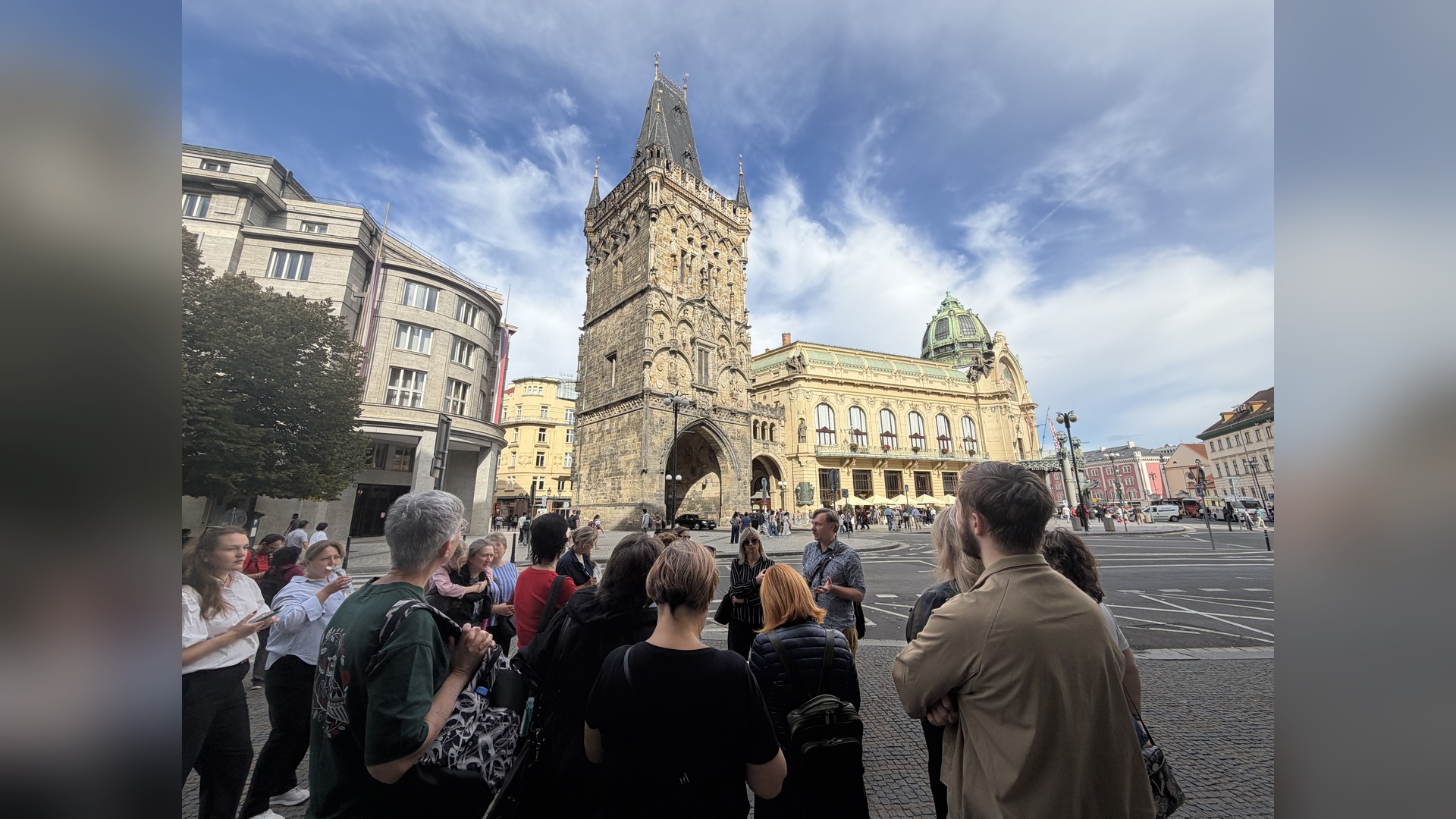
The theme of the walk was “Three Queens in the History of Prague and Medieval Ukraine-Rus’.” Using the examples of specific historical figures, participants learned how to use urban space as a tool for talking with children about history.
“I talked about how you can essentially create a walk in the form of an excursion, present school-curriculum information, and do it unobtrusively, through conversations with children about important topics. It’s important to highlight the main points, focus attention on objects, and interpret them in a certain way,” said historian Volodymyr Poltorak.
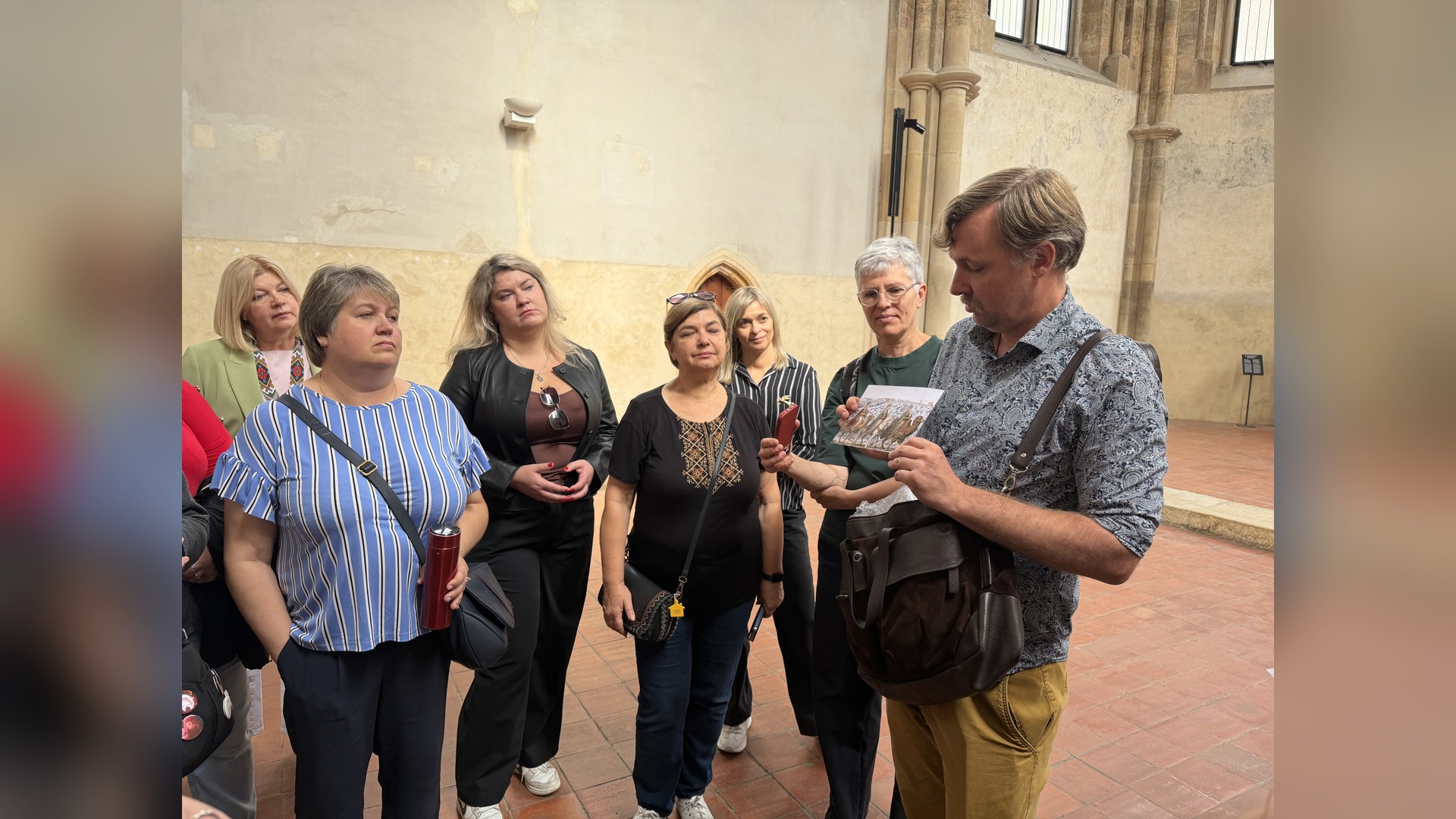
Participants also discussed how to connect the past with topics important to children today through historical narratives: personal choice, life decisions, and the role of the individual in society.
For Ivanna Karpa, who represents the organization “SRDCE LIDEM” in Prague, combining the history of Czechia and Ukraine was especially meaningful.
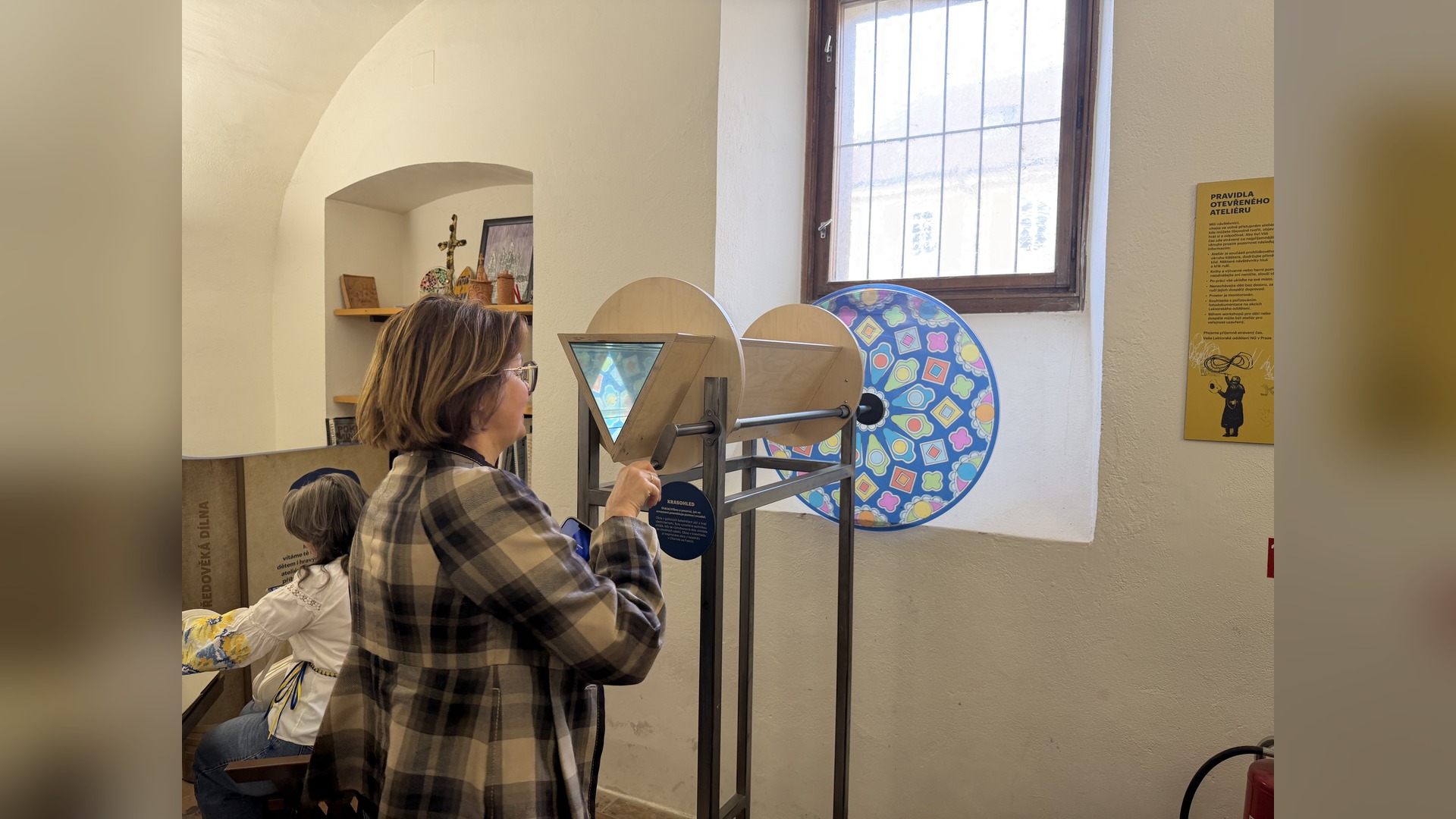
“I was very interested to talk with Mr. Volodymyr, because he is a historian, and to learn his perspective on some historical facts. The very building we entered is historic, Gothic, 14th century, with many interactive elements that can be introduced for children. And, of course, combining the history of Czechia and the history of Ukraine is very much needed, so that children have a clearer understanding of how closely related our peoples are,” she noted.
Olena Maksymenko, who also represents “SRDCE LIDEM,” highlighted the opportunity to work with history through direct experience.
“For the children we will be working with in the future, this is a wonderful way to see history firsthand and try to feel it with their own hands, since with the materials we saw, every child can approach, touch, and understand how it worked in the Middle Ages,” she said.
According to Olena Maksymenko, this approach is especially important for children of Ukrainian origin growing up outside Ukraine:
“A child who was born or is growing up in Czechia, of course, loses touch with Ukraine, but this way they understand that even here, while living in another country, I am Ukrainian, and a part of my history is here with me.”
The walk was part of a broader program of the first in-person module, dedicated to methods of working with Ukrainian history. According to the program’s author and curator, Natalia Omelchuk, participants worked, among other things, with the “Memories in Boxes” method — examining materials, ways of using them with different age groups, and possibilities for adapting them for educational hubs and community organizations.
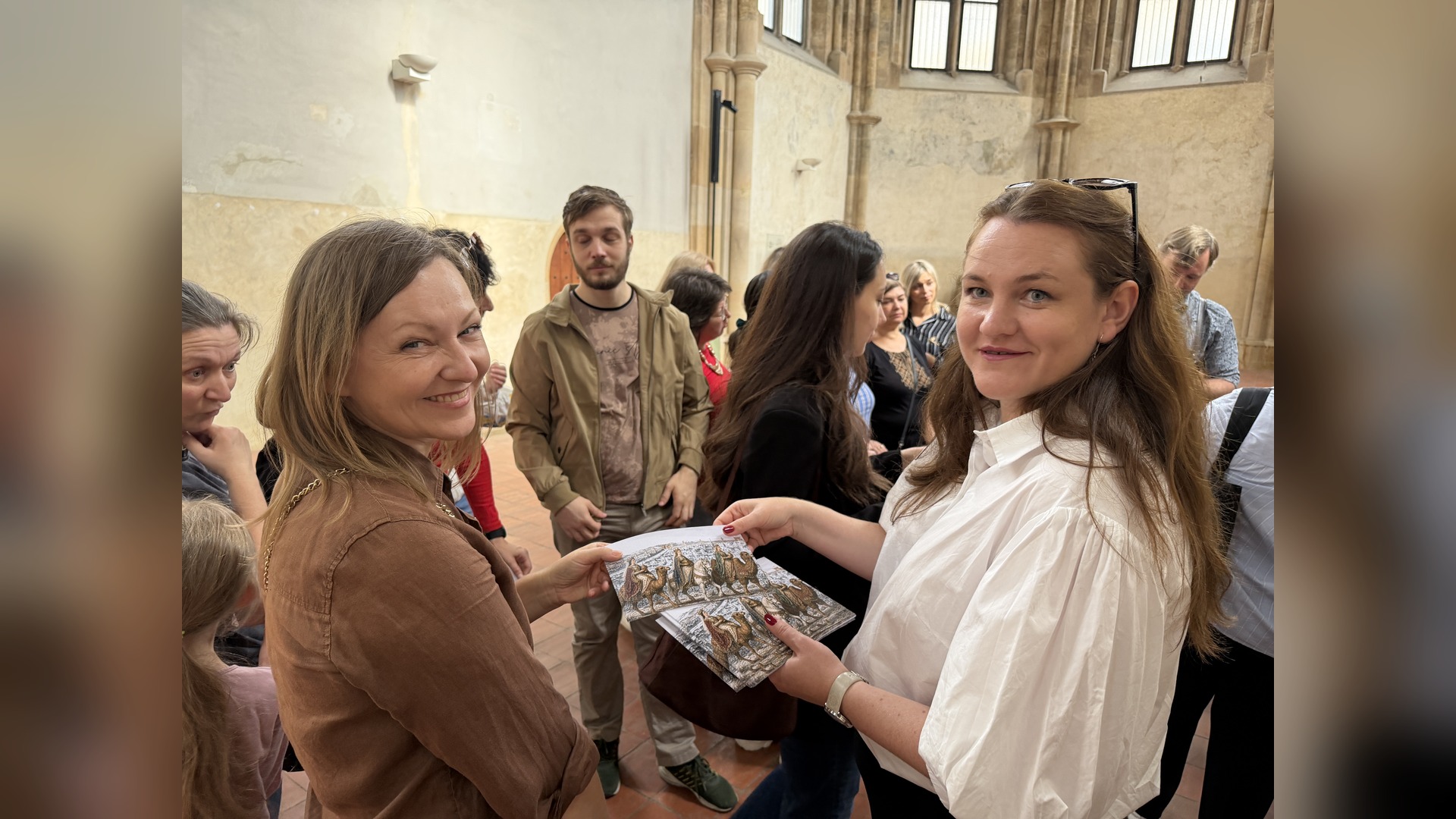
An important part of the module was a museum visit. This year, work with the walk as an educational method was also added to the program — participants not only received theoretical tools for creating excursion routes but also saw a ready example during the practical walk through Prague.
“Now participants have not only a theoretical understanding of how to form excursion routes and what is important to stop at, but they can also see what it looks like in practice, what can be prepared and used during such sessions,” said Natalia Omelchuk.
Separately, during the meeting, participants discussed the challenges faced by Ukrainian educational and community initiatives abroad, as well as how to adapt educational programs to different local conditions.
One of the results of the first module was the expansion of the range of formats in which participants plan to work with Ukrainian history. According to Natalia Omelchuk, this year not only Ukrainian Saturday and Sunday schools joined the program, but also Czech general education schools, where the Ukrainian language and history can be taught as additional subjects.
“This year we see a new turn — how this program and approach can be implemented not only in Saturday and Sunday schools, but also in local schools, if the country’s legislation allows it. I’m happy that the participants knew about this opportunity, arranged it with schools and parents, and now in three Czech schools, three groups of children will be studying the history of Ukraine,” Natalia Omelchuk noted.
Among the program’s participants are representatives of educational initiatives with various formats of work. In particular, teachers from Czech schools who are introducing Ukrainian language and history as additional subjects took part in the training, as well as representatives of five-day national schools in Hungary, where teaching takes place in Ukrainian and Hungarian.
“It was very heartening, and it was interesting to hear about their experiences, about how they are already planning to implement this. These are dedicated teams who are looking for opportunities, gathering children from Ukraine — both those who have long been in their host countries and those who have just arrived and are looking for a community where they can speak Ukrainian, learn the Ukrainian language, literature, history, and art,” said Natalia Omelchuk.
Preparations for the meeting also took place under conditions of Russian shelling of Kyiv and Kyiv Oblast. According to Natalia Omelchuk, three weeks before the start of the program, a Russian strike destroyed a print run of materials prepared for participants, and a week before the meeting, the production facility where part of the materials were being printed was damaged. The team had to quickly find alternatives so that participants would receive the necessary materials already during the training.
Despite these circumstances, the first in-person module concluded with planning for next steps. Participants will soon receive study materials for work in their organizations and will begin implementing the “Introduction to History” course.
Natalka Prokip, a representative of the Diocese of the Greek Catholic Church in České Budějovice, plans to use the knowledge gained to launch a new part of the program in her community.
“This is above all new knowledge, new skills, advice, and also the experience of my colleagues who have already implemented the first part of the project. We will be implementing the introduction to history for the first time, because we are currently already carrying out discussions, the second part of the project. I’m glad I was able to learn how to approach specific knowledge correctly and in the best way,” she said.
The next in-person meeting of participants will take place in November 2026. Its theme will be human rights and freedoms during war and ways of talking with students about tragedies. The sessions will take place ahead of November 17 — the Day of the Struggle for Freedom and Democracy in Czechia.
“Koreni ta Kryla: Istoriia, Yaka Ob’iednuie” (“Roots and Wings: A History That Unites”) is a year-long educational mentoring program of the Pylyp Orlyk Foundation for Ukrainian schools, community organizations, educational initiatives, and cultural-educational centers working with Ukrainian children abroad.
The program’s second season involves 21 representatives from 11 Ukrainian schools and educational initiatives from Czechia, Austria, Hungary, Spain, and Slovakia.
The program organizer is the Pylyp Orlyk Foundation. Partners are the Embassy of Ukraine in the Czech Republic and the Ukrainian Institute in Prague.


