
The event was held by the National Museum of Ukrainian History and timed to the 160th anniversary of Hrushevskyi’s birth. His birthday is marked every year on September 29. A few hours before the discussion, the Russians struck the building of the Presidium of the National Academy of Sciences of Ukraine with a drone. The building was on fire, and the explosion damaged its upper floors. There are reports of people killed and injured. Historian Oleksandr Kucheruk noted that today’s Kyiv realities differ little from the conditions in which Hrushevskyi had to live and work.
“Today the Russians attacked the building of the Presidium of the National Academy of Sciences of Ukraine. In 1917–1918, the sessions of the Central Rada chaired by Mykhailo Hrushevskyi were held in the building across the street (today it is the Teachers’ House. — Ed.). Then, as now, the sound of shelling echoed through the streets of Kyiv. But the Central Rada did not stop working. There are memoirs in which Hrushevskyi asks those present to move away from the windows so that people would not be showered with shards if the panes shattered,” the historian said.
At the National Museum of Ukrainian History, Oleksandr Kucheruk heads the “Museum of the Ukrainian Revolution of 1917–1921” sector, so the figure of Hrushevskyi is especially close to him in the context of his research focus as well. In addition to moderating the discussion, he also presented newsreels with the only surviving video footage of the Central Rada leadership, filmed in December 1917. Although the film was censored by the Soviet authorities, it makes it possible to appreciate the scale of the social changes and to see the features of the people who lived and shaped those historic times.
Kucheruk showed on video how Volodymyr Vynnychenko, the first head of the Directorate of the UPR, preens himself and adjusts his coat so as to look good in the newsreel. How Odesa haidamaks steal glances at the camera and laugh into their moustaches. At the entrance to the Central Rada building, a huge queue of people can be seen — this was a typical sight, as people had countless questions and proposals for the new government. In other footage, Mykhailo Hrushevskyi, with his signature beard, greets the crowded Parade of the Free Cossacks from a balcony.
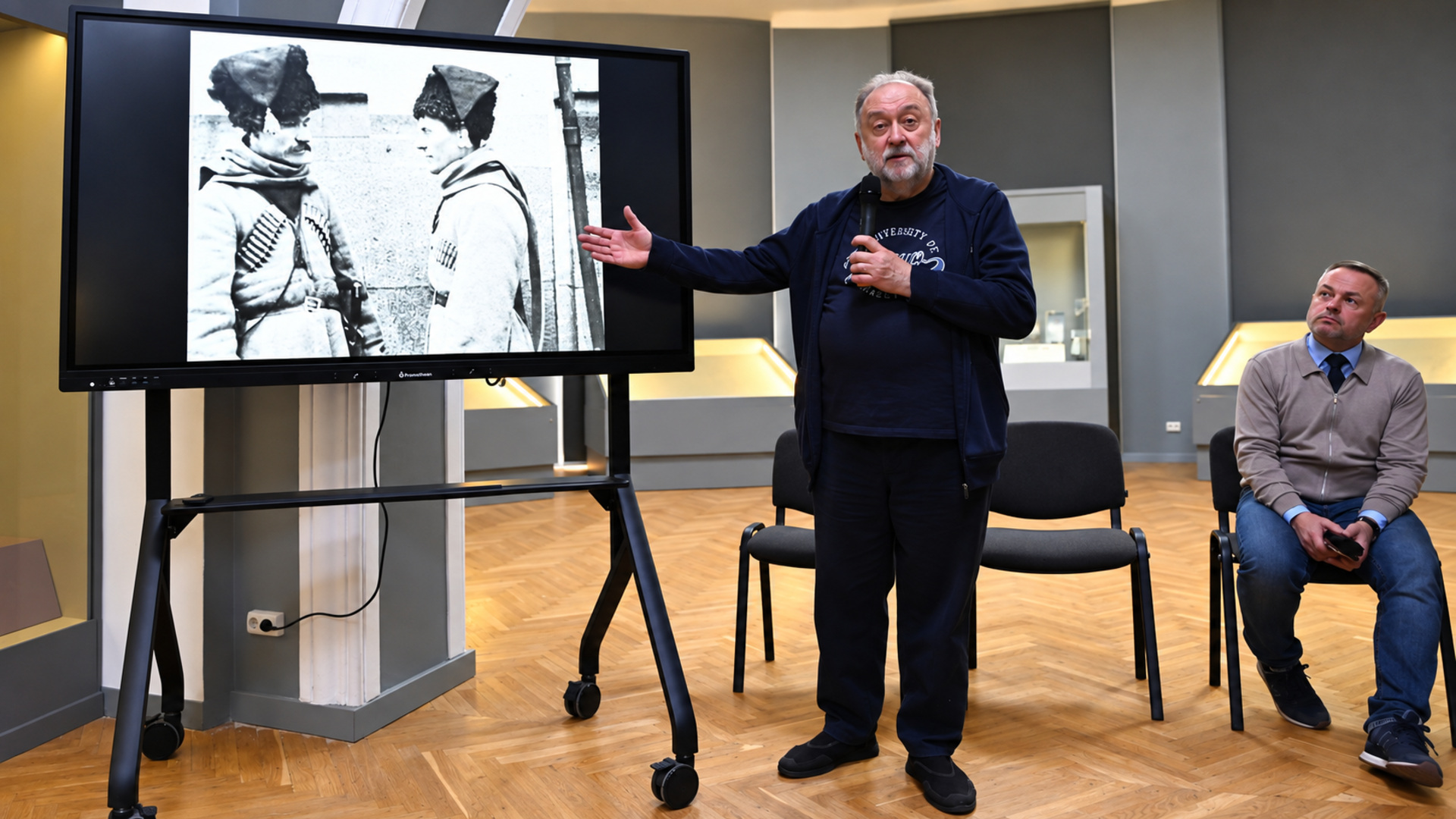
The newsreels exude that mood of national upsurge and general anxiety so familiar to modern Ukrainians from the time of the restoration of independence — from the Revolution on Granite to the Revolution of Dignity. Oleksandr Kucheruk noted that all our present achievements are possible also thanks to what Mykhailo Hrushevskyi managed to do in his time.
And in a year as head of the Central Rada of the UPR, he accomplished enough for Ukrainian statehood to become an established fact — even despite the subsequent occupations, Kucheruk explained. According to him, it was Hrushevskyi who pulled the metaphorical cart of the state out of the “eastern-northern” imperial swamp by means of the four Universals and the Constitution — the “Statute on the State System, Rights and Freedoms of the UPR”, even though it was adopted on the last day of the Central Rada’s existence.
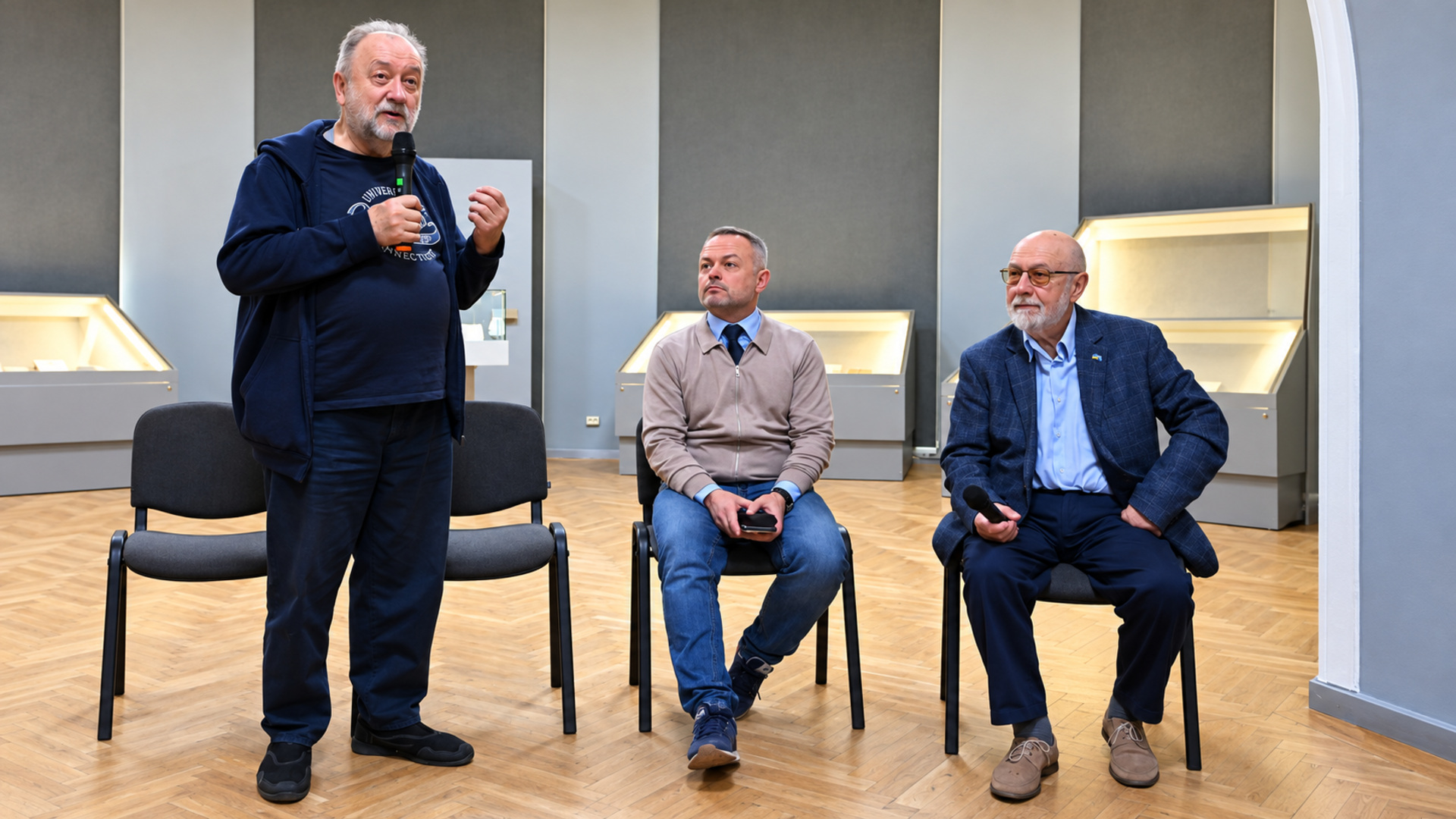
Historian Heorhii Papakin is the director of the M. S. Hrushevskyi Institute of Ukrainian Archaeography and Source Studies of the National Academy of Sciences of Ukraine. He added a few strokes to the portrait of Hrushevskyi as the creator of Ukrainian scholarship. Although we know Volodymyr Vernadskyi well as the founder of the Ukrainian Academy of Sciences, at that time he did not see himself as Ukrainian and viewed our Academy as a regional branch of the Petrograd Academy. Meanwhile, Hrushevskyi practically from scratch wrote Ukrainian history, a world history with Ukraine in the general context, a history of Ukrainian literature, and studies in ethnography, sociology and primitive society.
Both Papakin and Zinchenko noted that Hrushevskyi and his students wrote so many studies that it is now difficult for contemporaries to reread them all. Heorhii Papakin remarked that scholars have long cherished the idea of publishing a multi-volume edition of Mykhailo Hrushevskyi’s entire scholarly legacy. But due to a lack of funding, this has never been fully realized — 20 of the planned 50 volumes have been published. Papakin also added that the Ukrainian political elite has still not grown up to the scale of Hrushevskyi’s figure. Despite the wave of national upsurge, no government has marked Hrushevskyi’s anniversaries or the anniversaries of his death at the state level.
Co-founder of “Istorychna Pravda” (Historical Truth), historian and publicist Oleksandr Zinchenko helped the audience immerse themselves in the context of the era in which Mykhailo Hrushevskyi lived and built Ukrainian statehood. At that time, the Ukrainian state had no institutional foundation whatsoever, so our founding fathers built the UPR from scratch. Proclaiming the Universals was only the first step. Next, it was necessary to create the preconditions for the Universals to work. Hrushevskyi tried to do this amid political instability, three waves of epidemics, an external military threat and inflation that reached one million percent. On top of everything, the Ukrainian nation itself was unbalanced.
Zinchenko cites an example from the memoirs of Yevhen Chykalenko, a member of the Central Rada, patron of the arts and landowner. At that time, military commanders carried out so-called Ukrainization in their units. It was done in such a way that first the Ukrainians were to step forward, then the “Little Russians”, then the “khokhly”. In the end, it turned out that the entire unit was Ukrainian — the people simply did not perceive themselves that way. Hrushevskyi did his utmost to bring about this awareness.
Hrushevskyi was a very complex, vivid and inconvenient personality. He spent his childhood and youth in the Caucasus, as his family moved there because of his father’s service. There he learned to empathize with subjugated peoples and saw with his own eyes what lies behind the phrase “woe to the vanquished”. He greatly valued family and faith — he went to church almost every day, even just to spend some time there. His diary entries testify to this.
He received unusual proposals, such as to proclaim himself dictator — this, for example, was conveyed to him on behalf of fellow politicians by Nadiia Surovtsova, an employee of the Ukrainian diplomatic service. Hrushevskyi was, to put it mildly, not thrilled: “I, the head of the Ukrainian parliament, a dictator?..”. Contemporaries recall that the idea seemed outrageous and humiliating to him and made him terribly angry.
Oleksandr Kucheruk noted that the Soviet authorities tried in every possible way to diminish his role and consign him to oblivion. But Hrushevskyi left such a prominent mark that it turned out to be impossible:
“Behind all the landmark events and achievements of those times, one can glimpse that famous beard of Hrushevskyi. As a person, as a founding father of our statehood, as a scholar and researcher, he deserves to be known, loved and respected by his descendants,” Kucheruk concluded.
The discussion dedicated to the memory of Hrushevskyi took place in a hall renovated with the support of the Pylyp Orlyk Foundation:
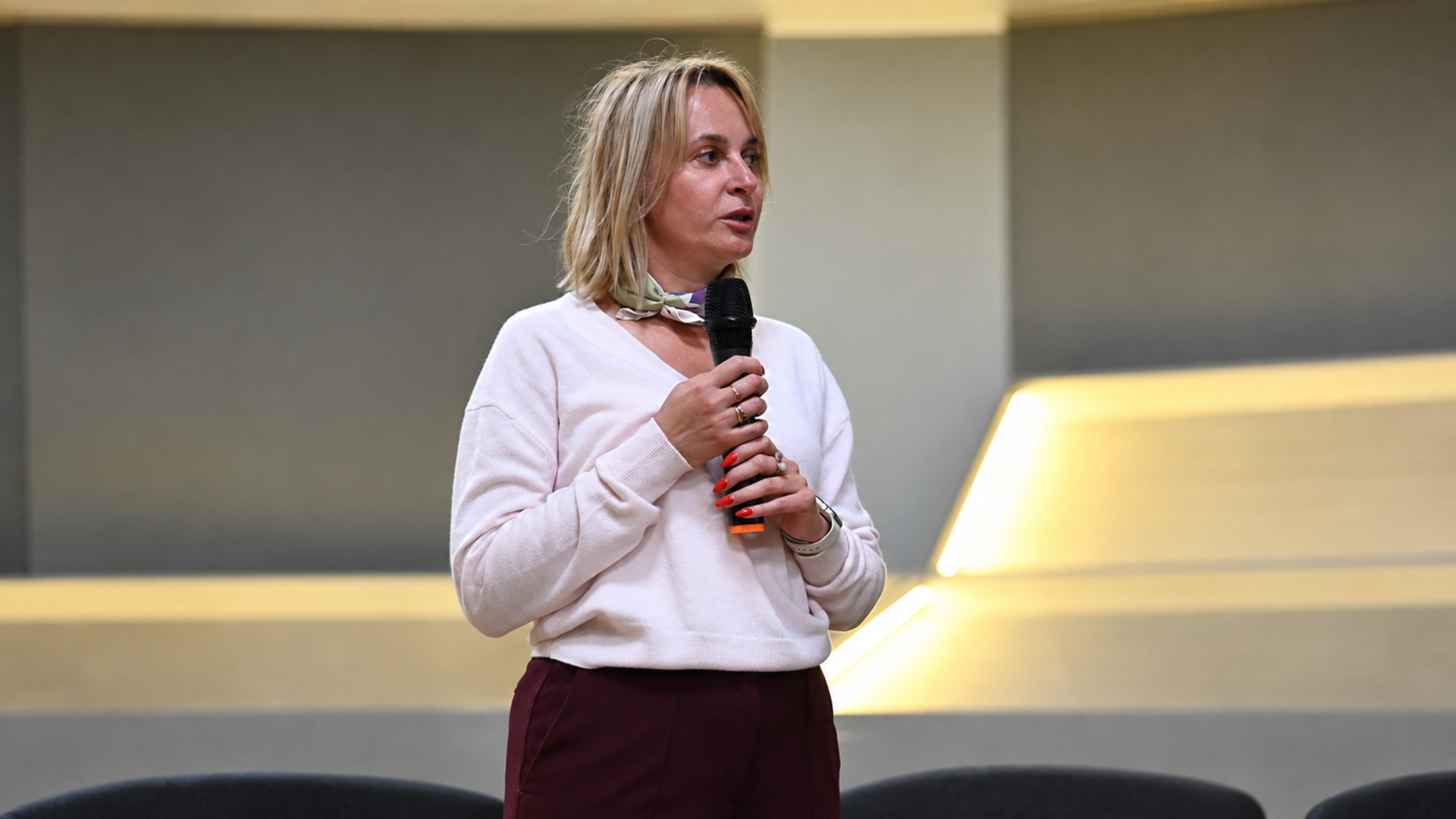
“This is exactly the kind of meeting we created it for: so that people could speak openly about history here,” said Svitlana Kvitnytska, project manager of the Pylyp Orlyk Foundation, who attended the event. “We are glad to continue supporting the National Museum of Ukrainian History. It is a wonderful venue where people not only learn about the past but also better understand the present. On the eve of Mykhailo Hrushevskyi’s 160th anniversary and in the context of yet another Russian aggression, we feel particularly keenly how important this is.”
As a reminder, in April 2026 the Pylyp Orlyk Foundation and the National Museum of Ukrainian History signed a Memorandum of Cooperation. It provides for funding the renovation of the museum space, supporting exhibition projects and developing new formats of interaction between the museum and its audience.


