
The summit, organized by the Center for US-Ukrainian Relations (CUSUR), has for over a decade been one of the most authoritative forums bringing together leading American and Ukrainian diplomats, politicians, security experts, think-tank representatives, and civil society figures to assess the state of Ukraine and discuss its future.
Among this year’s participants were the Ambassador Extraordinary and Plenipotentiary of Ukraine to the United States Olha Stefanishyna, Lieutenant General Ben Hodges, members of the US Congress and the Canadian Parliament, members of the Verkhovna Rada of Ukraine, as well as representatives of IRI, NDI, RAND Corporation, the Atlantic Council, the Hudson Institute, and other influential American institutions and universities.
The Annual Report Card Format: A Yearly Assessment of Ukraine
What makes this summit distinctive is its format. Since 2010, participants have each year compiled a kind of “report card” for Ukraine, assessing the country’s progress and challenges across key areas: democracy, economy, general security, energy security, social cohesion, and national identity. That is why the event is called the Annual Report Card.
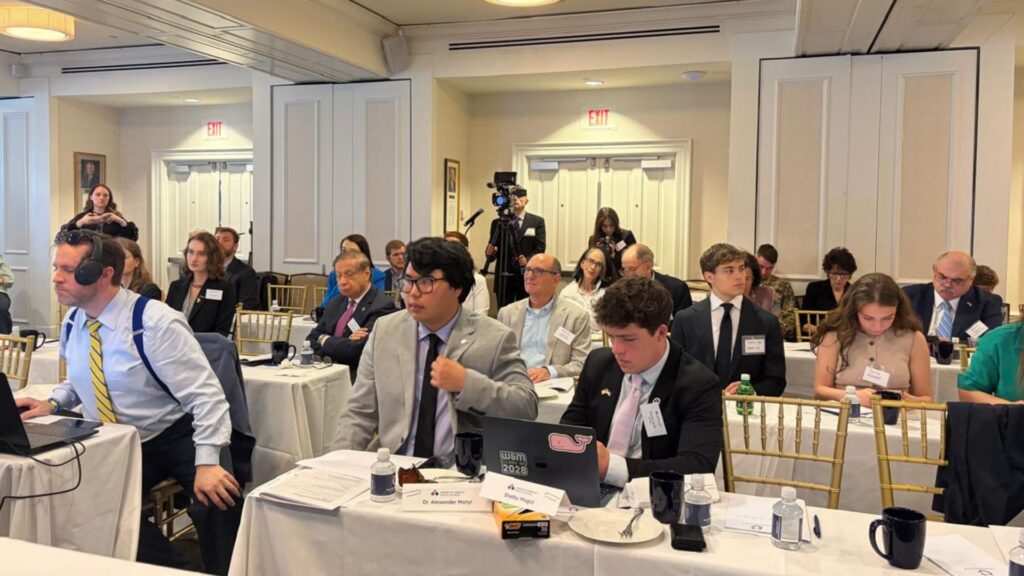
Opening the summit, CUSUR Executive Director Walter Zaryckyj noted that the Annual Report Card project has for many years served as a kind of barometer of Ukraine’s development. He drew attention to the fact that despite the war, the difficult international situation, and numerous forecasts of a Russian offensive, in 2025 Ukraine received the highest scores in the history of the study.
“Today even Putin’s most hawkish supporters acknowledge: Russia will not win this war,” Zaryckyj said.
It is significant that after Russia’s aggression began in 2014, summit organizers emphasized the need for ongoing monitoring of the Ukrainian state, warning that Russia might not stop at the occupied territories and could attempt to expand the war. The events of 2022 only confirmed the relevance of that approach.
Ukraine Remained a Wartime Democracy
During the summit, Ukraine’s Ambassador to the United States Olha Stefanishyna emphasized that Russia had failed to achieve one of its main goals — destroying Ukrainian statehood.
“Even during the war, Ukraine remained a functioning state. We remained a wartime democracy in wartime,” she said.
This resilience of the state and society became one of Ukraine’s key achievements during the years of the full-scale war.
Former US Ambassador to Ukraine John Herbst stressed: “The extraordinary achievements of your defense industry and Armed Forces have already placed Ukraine in a position where it can deliver precision strikes up to a thousand miles deep into Russian territory.”
According to Herbst, such strikes are already creating serious problems for Russian military logistics, ammunition production, fuel infrastructure, and the supply of occupation forces, and are producing noticeable changes on the battlefield.
Speaking about the price Ukraine pays daily for its freedom, Olha Stefanishyna also mentioned the recent Russian strike on the Kyiv-Pechersk Lavra. She emphasized that Russian strikes endanger not only human lives and civilian infrastructure, but also heritage sites belonging to Ukrainian and European cultural patrimony. That is why support for Ukraine remains a matter of defending not just a state, but shared European values.
Yaryna Yasynewych: Democracy and Unity Reinforce Each Other
Pylyp Orlyk Foundation Program Director Yaryna Yasynewych was invited to the summit as an expert on the panel discussion devoted to Ukraine’s democratic development and social cohesion in wartime. Together with representatives of the International Republican Institute, the US Helsinki Commission, and the Congressional Office for International Leadership, Yaryna Yasynewych discussed the state of Ukraine’s democratic institutions, the role of civil society, independent media, interethnic and interfaith relations, and the factors helping Ukrainian society maintain its unity in the fourth year of full-scale war.
The discussion was moderated by Atlantic Council Distinguished Fellow and former US Ambassador to Ukraine William Taylor. Other panelists included IRI Eurasia Regional Director Stephen Nix, Bush School of Government Senior Lecturer Kateryna Shynkaruk, longtime US Helsinki Commission advisor Orest Deychakiwsky, and Congressional Office for International Leadership Director Louis Madanic.
Yaryna Yasynewych emphasized that one of the main sources of Ukraine’s resilience remains a strong civil society.
“A democratic society is the guarantee of lasting civic unity, and in turn, civic unity is the guarantor of democracy’s preservation,” she said.
According to the Pylyp Orlyk Foundation’s Program Director, despite years of war and Russian information attacks, Ukrainian society demonstrates a high level of cohesion and an ability to resist Russian propaganda’s attempts to create or deepen internal conflicts.
Yaryna Yasynewych underscored that Ukrainian unity rests not on the authority of any single political leader, but on horizontal ties between people formed during the Revolution on Granite, the Orange Revolution, and the Revolution of Dignity. It is precisely those ties, in her view, that became the foundation of societal resilience during the full-scale war.
The Role of the Diaspora and Ukrainian Experience for the West
Yaryna Yasynewych paid particular attention to the role of the Ukrainian diaspora, which for decades has helped preserve Ukrainian identity, historical memory, and international support for Ukraine. She noted that the war has been a test of democracy, but has simultaneously demonstrated the strength of Ukrainian civil society — its capacity for self-organization, self-criticism, and the preservation of unity even under the most difficult conditions.
These themes are especially important in the fifth year of the full-scale war. If at the start of the full-scale invasion the world was primarily assessing Ukraine’s ability to hold on the battlefield, today increasing attention is being paid to how the country preserves democratic principles, freedom of speech, and social cohesion under prolonged wartime conditions. Ukrainian experience is increasingly becoming a subject of study for Western partners.
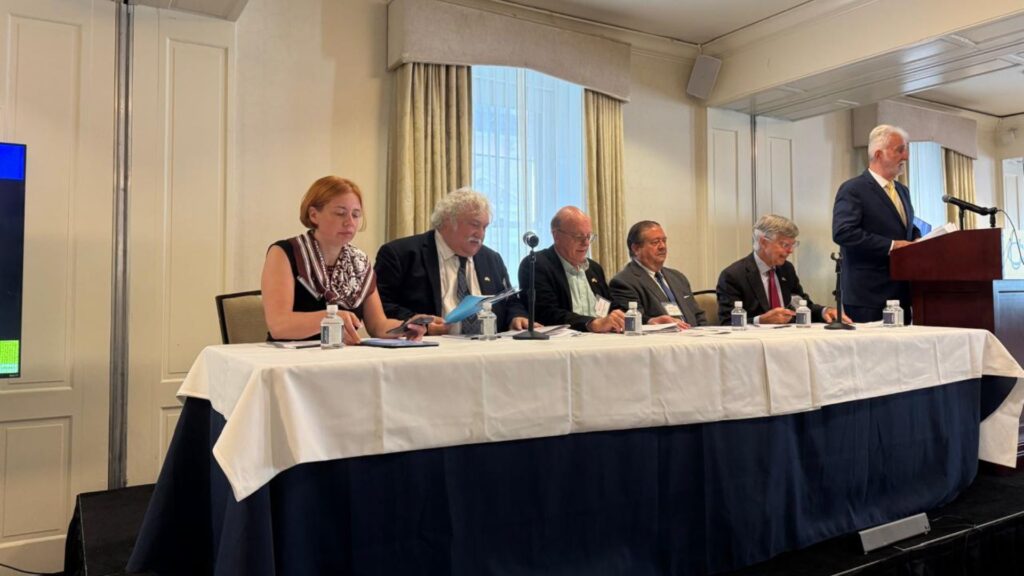
It is telling that a dedicated session of the summit was devoted to the role of history in understanding the Russian-Ukrainian war. Its keynote speaker was Volodymyr Viatrovych, a member of the Verkhovna Rada of Ukraine and historian. Participants discussed why it is impossible to understand the nature of the current war without examining the historical roots of Russian imperialism.
The Foundation’s Mission: Ukrainian Voices in Global Discussions
For the Pylyp Orlyk Foundation, participation in such international forums is an important part of the mission — to ensure the presence of the Ukrainian voice in global discussions on security, democracy, historical memory, and the future of Europe.
At a time when questions not only of Ukrainian but also of European security are being decided, it is vitally important that conversations about Ukraine be conducted not only by foreign experts, but by Ukrainians who work daily with issues of state-building, culture, civil society, and international politics.
As we previously reported, the Pylyp Orlyk Foundation actively represents Ukraine at international forums, bringing together the efforts of civil society and the diaspora.
The summit was organized by the Center for US-Ukrainian Relations (CUSUR) in partnership with a number of influential American organizations, including the American Foreign Policy Council, the International Republican Institute (IRI), the Congressional Office for International Leadership, and the U.S.-Ukraine Foundation.


